Category: Upcoming exhibitions

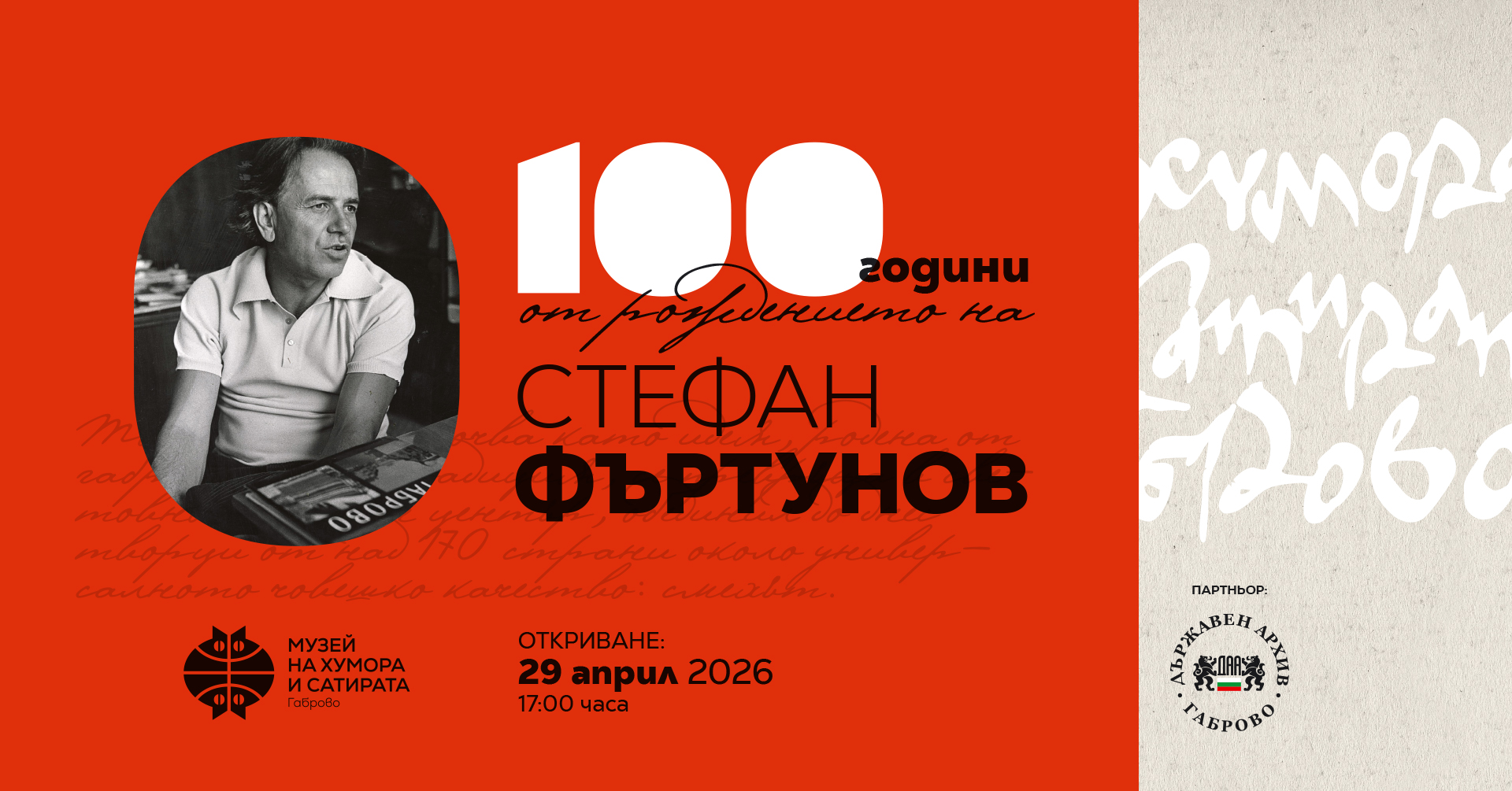
100TH ANNIVERSARY OF THE BIRTH OF STEFAN FARTUNOV100TH ANNIVERSARY OF THE BIRTH OF STEFAN FARTUNOV

Exhibition in the Park of Humor

Opening: 29 April 2026, 5:00 PM

The history of Gabrovo is a complex puzzle of events, places, and buildings, shaped by individuals of strong vision.

Among them the remarkable figure of Stefan Fartunov stands out — a man who devoted his energy and time to a bold dream: to establish and develop an institution dedicated to laughter, known as the House of Humor and Satire.

With clarity of vision and unwavering dedication, he transformed Gabrovo’s humorous tradition into a world-renowned centre that brings together artists and creators around a universal human quality — laughter.

We invite you to the opening of an exhibition dedicated to the 100th anniversary of the birth of Stefan Fartunov – creator, organizer and first director of the Museum “House of Humor and Satire”.


The exhibition is realised in partnership with the State Archives – Gabrovo.

Special thanks for their support to the Municipality of Gabrovo and the Municipal Enterprise “Urban Development”

JUST CATSJUST CATS

Photo Exhibition by Veselin Borisev
April 1 – June 30, 2026
Opening: April 1, 2026, 4:30 PM
Floor 4, Hall 8

The author of Just Cats doesn’t describe himself as a cat lover. Yet, despite his preference for dogs, cats have always been part of his life. Today, he and his family share their home with two dogs and one cat.

Urban or rural, domestic or free‑roaming, black, white, or multicolored, lazy or restless, aloof or affectionate—no cat appears alone in the photographs of this exhibition. In every portrait, one senses the eye behind the lens: Veselin Borishev watching, observing, connecting. It feels like love.

The photographs in Just Cats belong to a larger, still-unshown project titled Pets and Other Species.

About the author

Veselin Borishev, a Bulgarian photographer born in 1967 and a graduate of Sofia’s National High School of Fine Arts, is renowned for his compelling fine art and photojournalistic work.

His artistry transitions between traditional film and digital photography, utilizing both black-and-white and color to explore varied, always conceptual themes. Rejecting stylistic boundaries, he engages in constant experimentation. His images convey a raw honesty, often brutally sincere.

PUSTA VE4NOST / BLANK ETERNITYPUSTA VE4NOST / BLANK ETERNITY

The Museum of Humor and Satire presents:
PUSTA VE4NOST / BLANK ETERNITY
Exhibition by Filip Boyadzhiev

April 1 – June 30, 2026
Opening: April 1, 2026, 6:00 PM
Floor 2, Giraffe Hall


The exhibition BLANK ETERNITY by visual artist Filip Boyadjiev explores the mechanisms through which contemporary social images transform into cultural mythologies. The project continues the line of theconTEMPORARY HEROES series, in which the author works with the figure of the so-called “traditional bulgarian man” – a character that is both familiar and hyperbolized, constructed from various layers of post-socialist culture. This figure emerges as a kind of hero of our time – a self-proclaimed patriot who builds his own symbolic universe from signs of status, power, and belonging.

The central element is a spatial installation composed of thousands of empty metal cans, forming a monumental environment reminiscent of a sanctuary. This space can be interpreted as a temple, built by the hero himself as an attempt to leave a trace and secure his presence in eternity.

The forced encounter between two cultural models – Bulgarian pseudo-patriotism and ancient Egyptian tradition – creates a distinctive clash. The archetype of eternity is refracted through the local context and turns into a grotesque form, where the desire for grandeur mixes with an element of absurdity. The temple that the hero constructs is both monument and stage set – a space in which the aspiration for immortality is marked by its own irony.

In the exhibition, the hero dissolves into a system of objects and symbols. Fragments of everyday life function as cultural markers that shape a visual vocabulary of a hybrid identity attempting to stand simultaneously in the past, present, and future. The black color covering the objects in the installation functions as a final gesture of intervention by the artist. The shine of the symbols is absorbed and neutralized; the objects become silhouettes devoid of individuality. Thus, the desire to shine turns into a gesture of self-extinguishing, the pursuit of greatness transforms into an image of one’s own emptiness, and the hero’s ego gradually becomes grotesque.


After its highly successful presentation in Sofia, the exhibition moves to Gabrovo – a city that, in the Bulgarian cultural context, is closely associated with traditions of humor, self-irony, and social critique. Presenting the project at the Museum of Humor and Satire creates a new context of the work, which is not simply a re-presentation of the exhibition but its conceptual continuation. The encounter between the project and the specific cultural environment of Gabrovo highlights the role of humor as a tool for critical thinking – the ability of society to recognize its own mythologies and question them.

The metal cans were provided with the kind assistance of Elena Tsvyatkova.

This project is realised with the financial support of the Ministry of Culture.

“Structures in Transition” – Curatorial School 2.0 Exhibition“Structures in Transition” – Curatorial School 2.0 Exhibition

Opening: 24.03.2026 at 1:30 p.m., Fourth floor, Museum of Humor and Satire

The exhibition “Structures in Transition” (24 March – 25 July 2026) is the culmination of the two‑month Curatorial School – an educational and practical program aimed at developing curatorial skills, critical thinking, and professional preparation in the field of visual arts.  

Within the context of the Bulgarian art scene, curatorial work often remains ambiguous. The initiative of the Christo and Jeanne‑Claude Center in Gabrovo seeks to create a sustainable framework for learning, collective practice, and public presentation. The school gives its 18 participants an opportunity for interdisciplinary collaboration – an approach inspired by the combination of different kinds of knowledge and experience characteristic of Christo and Jeanne‑Claude’s projects.  

Hosted by the Museum of Humor and Satire in Gabrovo, “Structures in Transition” is organized in three thematic sections, curated by three working groups mentored by Margarita Dorovska, Svetlana Kuyumjieva, and Vesela Nozharova. The participants also had the opportunity to consult with the lecturers Vasil Vidinski and Stanimir Stoyanov.

The exhibition includes works from the museum’s archive, brought into dialogue with the perspectives of young painters, contemporary artists, illustrators, and even photojournalists. The project explores the tension between the individual and society, revealing the many invisible ties and rules that connect them.  

Its three sub‑themes are “The Queue,” “The Game,” and “Taming the Monument.”

“The Queue” examines a familiar social phenomenon that speaks volumes about different historical periods – their shortages, needs, and aspirations. A line of people waiting for something is a democratic and self‑regulating structure, yet it can easily become a monument to passivity or a vicious circle. Group “The Queue”: Ivana Borisova, Maria Borisheva, Yoshka Mihaylova, Iva Rudnikova, Krastina Stefanova, Emilia Stoeva 

Taking as its starting point the local case of Chardafon in Gabrovo – a monument whose head was replaced by those in power more than once – “Taming the Monument” investigates the “beheading” of monuments both literally and metaphorically: as the end of an ideological narrative and as a process revealing public memory as a field of continual rewriting. Every monument has an ideological lifespan. Group “Taming the Monument”: Hristina Decheva, Martina Grueva, Ivelina Ivanova, Kalina Ivanova, Teodora Marinova, Marina Kisyova de Heus

“The Game” segment, inspired by Johan Huizinga’s concept of Homo Ludens (“the playing man”), looks at play not only as entertainment or an escape from reality but also as a fundamental principle through which a society understands, constructs, and resists the world. The works presented analyze the mechanisms of (dis)empowerment that shape our reality, leaving room for experimentation and a reconsideration of the rules by which we live. Group “The Game”: Paola Dimova, Aleksi Ivanov, Natalia Krisenko, Ekaterina Leondieva, Ralitsa Petkova, Ana Radkova, Elena Tsvyatkova 

“Structures in Transition” runs until 25 July 2026 at the Museum of Humor and Satire in Gabrovo.  

Participating artists: Zhenya Adamova, Velko Angelov, Zhivko Angelov, Ivo Bistrichki, Tsvetomira Borisova, Veselin Borishev, Lachezar Boyadjiev, Panayot Barnev, Anna Vasof, Alexander Valchev, Ivan Grigorov, Damyan Damyanov, Petra Dimitrova, Angelariy Dimitrov, Evgeni Dimitrov, Stefan Ikoga, Hristo Komarnitski, Veselin Kostadinov, Ivan Landzhev, Roxana Markova, Yoshka Mihaylova, Ivan Moudov, Stefan Nikolaev, Alina Papazova, Adrian Paci, Nia Pushkarova, Kamen Stoyanov, Isao Hashimoto, Veronika Tsekova, Valko Chobanov, Venelin Shurelov, Geri Georgieva


Curatorial School 2.0 is a project by the Christo and Jeanne‑Claude Center and Plakat Combinat Ltd., funded under procedure BG‑RRP‑11.021, Grant Scheme “New Generation of Local Cultural Policies for Major Municipalities,” Investment “Development of Cultural and Creative Sectors,” Component “Social Inclusion,” National Recovery and Resilience Plan.


Opening Brieftopia: Art Between Crisis and ImaginationOpening Brieftopia: Art Between Crisis and Imagination

21.03.2026 – 30.06.2026

First International Laboratory for the 26th Gabrovo Biennial of Humor and Satire in Art

Participating artists:
Voin de Voin, Nevena Ekimova, Armando Lulaj, Ivan Moudov, Maria Nalbantova, Behzad K. Noori, Boryana Petkova, Antoni Rayzhekov, Lexi Fleurs, Luka Cvetković

Curator: Snejana Krasteva
Museum of Humor and Satire, Gabrovo

The Museum of Humour and Satire presents the project “Brieftopia: Art Between Crisis and Imagination”, conceived as the first international laboratory leading toward the upcoming 26th edition of the Gabrovo Biennial of Humor and Satire in Art, to be held in 2029. The project takes the form of a group exhibition featuring newly commissioned works in a variety of formats—from performance and video to installations, seminars, and workshops—created specifically for the laboratory by international and Bulgarian artists.

The term “Brieftopia” is a neologism combining brief and utopia. Introduced by Iranian-Swedish artist and researcher Behzad K. Noori (a participating artist and co-curator of the next Gabrovo Biennial), it describes a fleeting yet powerful form of utopian imagination oriented toward an accessible and tangible future. As Noori writes, it is “a brief moment in which art intertwines with the politics of imagining plausible futures, in order to envision a tangible future that offers temporary refuge and potential paths for navigating existence.”

Brieftopia functions simultaneously as a critical working method and a research approach, drawing on one of the key hard-won privileges of contemporary art—its freedom—in order to resist what Mark Fisher has termed the “slow cancellation of the future.” According to Fisher, we live in an era in which everything can return from the past like a zombie, where cultural differences lose their specificity, and where the present stretches into an endless presentism marked by a pervasive sense of hopelessness toward the future.

Brieftopia, however, thrives precisely between hope and hopelessness—as a form of hopeless optimism. Art offers a space in which alternative models of co-existence can be tested on a small scale, where operations on time can be performed (stretching, compressing, looping, stopping, reversing, or fast-forwarding it), and where essential mental processes—abstract and concrete thinking alike—can be freely “practised” through bodily and sensory experience.

In the exhibition, the artists reflect on the concept of Brieftopia from multiple perspectives. At the very entrance, visitors are welcomed by Ivan Moudovs work “Brieftopka”, in which the artist, with the help of a local speech therapist, attempts to read the curatorial text “in the Gabrovo accent”. The gesture reverses the conventional practice of seeking to “correct” an accent and instead proposes a conscious immersion in local speech specificities—even if this lasts only as long as a curatorial text does. In this way, the “ball” is thrown back to the curator, whose introduction and the very concept of Brieftopia become potentially more accessible to a local audience.

Language and speech are also central to “Polit-Pong”, a work by Antoni Rayzhekov and Maria Nalbantova, their first collaboration. Visitors are invited into a “brieftopian” experience in which a game of ping-pong triggers sounds with each strike—sometimes difficult or even impossible—composed of fragments of speech: exclamations, sighs, and inarticulate sounds of discomfort extracted from processed interviews with key figures from Bulgaria’s political and public life after 1989.

In the interactive installation “Noise Floor”, Nevena Ekimova creates an environment for examining the informational “climate”—a device that registers momentary states of thought and oscillations between signal and noise, between critical stance and play. Luka Cvetković, in his installation “Celebrations 2029”, “reconstructs” the opening of the Gabrovo Biennial in 2029 and invites participants to “remember” imagined future states of the world, interwoven with personal narratives of love, family, success, and loss—raising the question of whether thinking the future is less a practice of prediction than one of memory.

Humour is a key tool and form of resistance in the exhibition, alongside imagination. The installation and live performance “Smile!” by Boryana Petkova affirms laughter as such an instrument, using female laughter—short, stifled, uncontrollable—as acoustic material to expose the moral and social control exerted over the body. The video work “I Hate War and War Hates Me” by Lexi Fleurs juxtaposes fragments of her visual communication with her fixer in Ukraine. Through them, we trace shifting emotional states—often with a comic effect—set against quiet, seemingly idyllic landscapes in which military operations are nevertheless unfolding. Meanwhile, Voin de Voins workshop “How Do We Organise Ourselves in Times of Chaos?” is oriented toward practical exercises aimed at cultivating skills necessary for regaining orientation and the capacity to act under conditions of instability.

Inspired by the large number of caricatures and unique collages in the museum’s collection by Iranian cartoonist Kambiz Derambakhsh, as well as by childhood memories of watching the animations of Donyo Donev on Iranian national television, Behzad K. Noori presents his new film, “Brieftopia, three and More Fools”. Shot within the museum, the film is narrated by the author in the form of a letter to his Iranian colleague, who will “receive” it posthumously, alluding also to the peculiar, brieftopian sensation one must have experienced when receiving mail at that time (something the collection of the museum is based upon historically), under conditions of political isolation.

Armando Lulaj presents part of his long-term project “THE DEEEPEST SOUND” as a series of 224 photographs that provocatively invite us to view the world not as a system governed by power and economy, but as a whole without borders or nations—exactly as it appears from outer space. As the artist notes, “art has always sought to imitate this possibility, even if only briefly and in miniature.”

Brieftopia: Art Between Crisis and Imagination marks the first step toward the 26th edition of the Gabrovo Biennial of Humour and Satire in Art, an established forum for contemporary art in Bulgaria and the region, to be curated by Snejana Krasteva and Behzad K. Noori. Through an open, multi-stage, and context-sensitive approach, the project aims to strengthen Gabrovo’s role as an active centre for contemporary art and international cultural exchange. The laboratory will include a series of events, tours, and workshops, as well as a two-day international symposium on 23–24 May 2026,  featuring distinguished speakers such as philosopher Boris Buden, political scientist Francisco Carballo, curator Maria Lind, artists, writers, and researchers Magnus Bärtås, Edgar Shmitz, Snejanka Mihaylova, and Peter Tzanev, among others.

More details about the project “Briftopia: Art Between Crises and Imagination”: https://humorhouse.bg/en/brieftopiaen/

The project is realised with financial support from procedure BG-RRP-11.021, New Generation of Local Cultural Policies for Large Municipalities, Investment Development of Cultural and Creative Sectors, Component Social Inclusion, National Recovery and Resilience Plan.


FANGIRLFANGIRL

Solo Exhibition at Museum of Humor and Satire

Curator: Reneta Georgieva

January 16 – February 16 2026

Opening: Friday, January 16, 6 PM 


In the exhibition FANGIRL, Nevena Ekimova embarks on a personal and artistic act of return  – towards herself, her past, and the men who inhabited it.

The project unfolds as an emotional retrospection of a kind, with Nevena tracing the threads of her feelings – attraction, idealization, shame, anger, sorrow, elation – directed at figures drawn from reality and fantasy, predominantly men. What emerges is an intimate yet biting archive of her experiences as a woman and as an artist, rooted in the very core of fangirl obsession –  a deeply feminine form of identification and projection, so often dismissed, yet charged with power. 

Having crossed the symbolic threshold of her forties, Nevena unfolds her artistic language – drawing, sculpture, textiles, words, and music – to map the inner world where archetypes and personal memories mingle like souvenirs: from the father as the first object of adoration and psychological formation, through the fleeting idols of adolescence and adulthood, to the gallery of men and boys in whom she has seen herself mirrored, fallen in love, been let down, and fantasized about.

The exhibition assembles emotional trophies from stories lived and left untold, visually archiving them into an intimate mythology.

FANGIRL is not merely an exploration of the desires seen through a woman’s gaze –  it is a candid confession of the artistic dependence on those desires, on fixation, on longing.

Here, fangirlism is neither a joke nor a diagnosis. It is a strategy – for resistance, for solace, for identification. The exhibition offers an emotionally charged yet conceptually grounded experience, in which the intimate autobiography transforms into a universally recognizable story – something between a teenage diary and a mature artistic confession. Nevena allows herself to be both serious and self-ironic, vulnerable and in control, fan and author – and it is precisely within this tension that her artistic maturity emerges.


Nevena Ekimova is a Bulgarian artist, currently based in her hometown of Gabrovo.

She studied contemporary art in Norway and Iceland, and got her BFA at the Valand Art Academy in Gothenburg, Sweden.

Since 2021, Nevena Ekimova has been working at the Museum of Humor and Satire.

Besides participating in exhibitions, she often works with public institutions and creates large-scale interactive projects for children and adults.

https://nevenaekimova.com


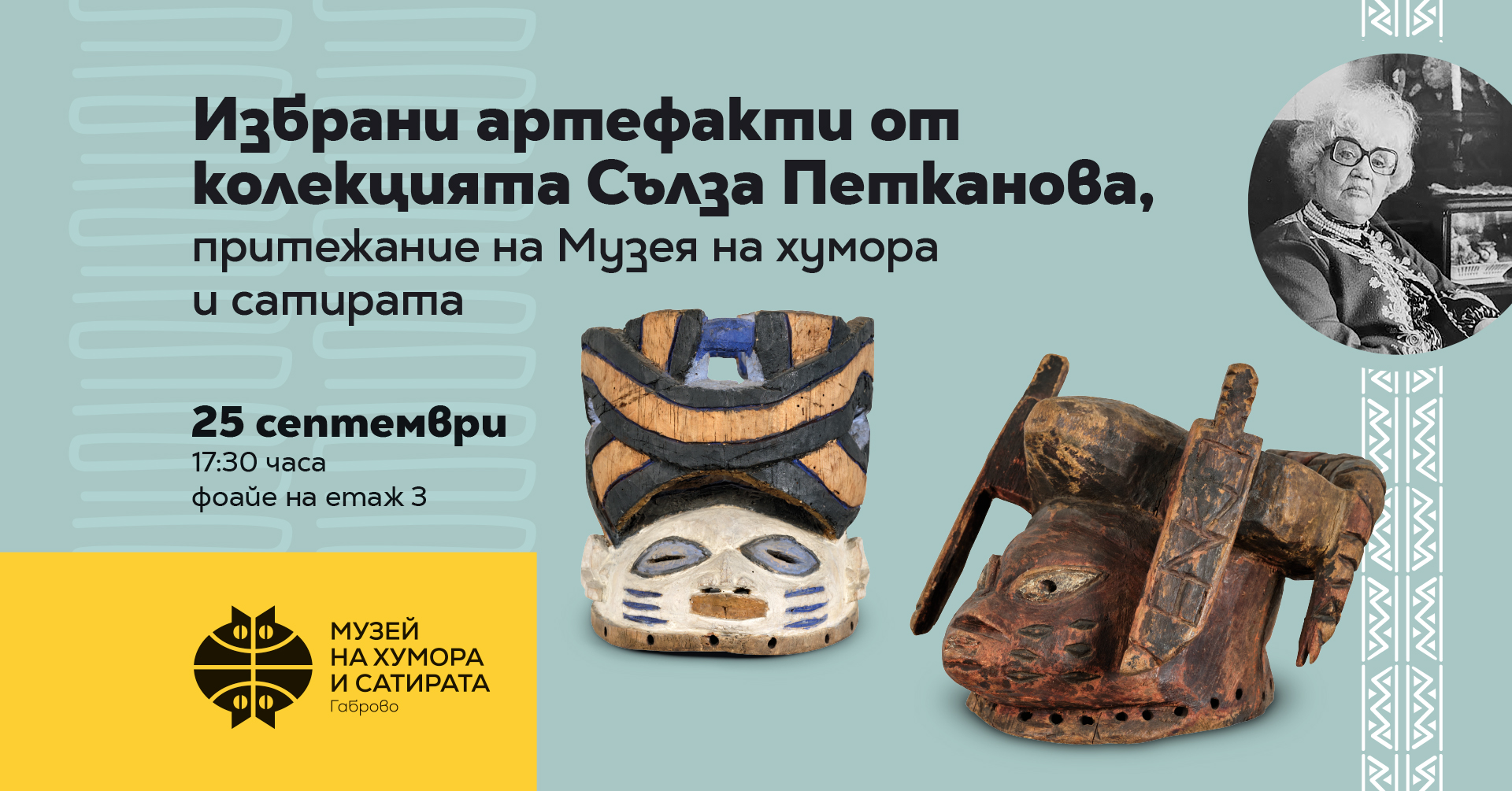
Selected artifacts from the collection of Salza Petkanova (1921 – 1997), owned by the Museum of Humor and SatireSelected artifacts from the collection of Salza Petkanova (1921 – 1997), owned by the Museum of Humor and Satire


From September 25, the Museum of Humor and Satire presents selected bronze figurines, gold measures and masks, mainly from the 18th and 19th centuries. The unique African pieces are not just exhibits, but bearers of centuries-old wisdom, with which Salza Petkanova introduces us in her books and research. The collection of ritual masks and sculptures is one of the most valuable investments that the Museum has made over the years.

Raised under the wing of writers Konstantin and Magda Petkanovi, Salza Petkanova is a polyglot, philosopher, psychologist, specialist in librarianship and African art. She is the first research associate at the University Library of Sofia University “St. Kliment Ohridski”. In 1965, she was sent as a specialist to Ghana. Later, she became deputy director and subsequently director of the Library of the University of Ghana in Accra, where she spent almost a decade. She returned to Bulgaria with a rich collection of works of African art. A significant part of it is now owned by the Museum of Humor and Satire. For many years, Salza Petkanova was the chairman of the association “Friends of Africa in Bulgaria”.

53 YEARS OF HUMOR: WE CELEBRATE WITH SMILES AND INSPIRATION53 YEARS OF HUMOR: WE CELEBRATE WITH SMILES AND INSPIRATION

According to one study, people are happiest at 53: it is assumed that they have achieved what they wanted, the children have grown up and they have time for themselves.

According to another, up to this age you are young, once you pass it you are already settled, calm and wise.

53 is a rather interesting number – it’s after 50 (aiming for 100), natural… – there are many more characteristics with which to describe and define it.

For us, its most important value is that this year the Museum of Humor and Satire reached it. We don’t know if the research also applies to museums, but since they, like any institution, are composed of people as their most integral parts, we think that it cannot but affect everyone connected with it.

The Museum of Humor and Satire invites you to its 53rd birthday and we hope to fill you with a lot of happiness, youth, freshness and interesting experiences in the early spring!

We hope that the Day of Joke and Lie in our country – a lie not as not telling the truth, but as an opportunity for fantasy, mood and changing roles for at least one day a year – will make you feel different, learn new things and have real fun.

Come visit us on our Open Day!

On April 1, with a festive program filled with creativity and lots of fun, we celebrate 53 years since the founding of our museum.


Program:

10:00 – 12:00

Little Actors, Big Smiles – onstage: children from Gabrovo kindergartens,

Hall 3 Stefan Fartunov

10:00 – 12:00

In the Service of Laughter – a meeting of colleagues with history – a Gabrovian party of people who made everything possible

13:00 – 15:00

Fun Museum Search Party – a family game with emotions for the whole family!

16:00 – 17:30

Creative workshop for comics with artists Petar Stanimirov, Rumen Chaushev, Ivan Berov and writer-screenwriter Marin Troshanov,

Hall 3 Stefan Fartunov

18:00

Opening of the Fourth National Exhibition of Bulgarian Comics, Hall 3 Stefan Fartunov

Entrance is free!

Don’t miss the opportunity to immerse yourself in the world of humor and satire and spend an unforgettable day with us!

We are waiting for you!


On April 1, 2025, the Museum of Humor and Satire will go beyond the borders of Gabrovo.

We will be visiting the Peter Stupov Regional Library in Targovishte with Masters of Bulgarian Cartoons from the 20th and 21st Centuries – a representative exhibition from our collection!

Masters of Bulgarian Cartoons from the 20th and 21st Centuries presents the audience with works by both classics in the genre and contemporary authors, known as winners of a number of prestigious international awards. The topics range from social and political irony to funny moments from everyday life, and all the works impress with masterful drawing and a subtle sense of humor.

But that’s not all! We will also virtually join the Sea Crabs Humor and Satire Club – part of the Burgas Writers’ Community. With a special video message, we will join their program to celebrate April Fool’s Day.


JOIN THE ULTIMATE COMIC BOOK WORKSHOP ON APRIL 1stJOIN THE ULTIMATE COMIC BOOK WORKSHOP ON APRIL 1st

On the festive April first, at 4:00 PM, come to a creative comic book workshop

with artists Petar Stanimirov, Rumen Chaushev, Ivan Berov and writer-screenwriter Marin Troshanov.

We will draw together and discuss the process of creating illustrated stories – from the first word to the last stroke.

The event accompanies the Fourth National Exhibition of Bulgarian Comics.

Admission is free.


Petar Stanimirov is one of our most productive comic book artists. He worked for the original edition of the Daga (Rainbow) magazine from 1979 until its closure in 1992. During this time, he drew six series, including Bubachko, Yantar and Treasure Island. In the 1990s, he created the comic book periodical Stories in Pictures. Later, he founded the publishing houses Pulsar and Mega, through which game books are popularized in Bulgaria. For many years, he also worked in the gaming industry as an art director at the Haemimont studio. After 2010, together with colleagues from the Daga magazine, he participated in the founding of the Project Daga Association, through which new comic books began to be published, including Nad Dagata (Over the Rainbow) and the Arakel series. 

Rumen Chaushev also worked for the original edition of the Daga magazine, for which he drew the series Yavor and The Girl from Earth. His drawing style and the stories in which he involves his characters Yavor and Alice are extremely recognizable and make them some of the most emblematic for the publication. In the early nineties, he drew the comic book Secret Under the Sea, and later illustrated numerous children’s books and textbooks. In 2010, he was a main driving force in the creation of the Project Daga Association and the revival of Bulgarian comics. Since then, he has drawn comics for the Nad Dagata publications, the Arakel and Vekovnitsi series. He has actively participated in the organization of over ten major comic exhibitions across the country.

Ivan Berov is an illustrator and animator. In his work, he is involved in the creation of scenarios, comics, storyboards, animated clips, interactive applications and games. He has participated in the creation of animation projects at Golpy studios and Zmey studio. He has drawn comics for the Komixer and Vekovnitsi publications. He has published stories in the third generation of the Daga magazine in 2022. He participated as a technical assistant on the Wormworld Saga comic series. Since 2021, he has served as deputy secretary of the comics section of the Union of Bulgarian Artists.

Marin Troshanov is a freelance writer and screenwriter. He works on various fantasy and journalistic works. He is the author of several very successful novels, including the trilogy Lamia Ltd and Emmy and the Shadow Thief. Together with Evgeni Proykov and the artist Petar Stanimirov in 2012 he created the comic Damga, which in a tough competition with 286 contenders from 29 countries won the award for best traditional comic at the international festival in Belgrade. In the next few years, again in collaboration with Petar Stanimirov and the screenwriter Anton Staykov, he created the series of children’s books about the Robot Chapek and his travels in space. They combine prose, illustration and comics in an innovative way for the Bulgarian market. Marin is the winner of the prestigious award of the National Palace of Culture, the National Book Center and the Peroto Literary Club in the Children’s Literature category (2019) and the national Konstantin Konstantinov award in the Author category (2020).