Category: Exhibitions

The presentation of the monograph “Boris Dimovski”The presentation of the monograph “Boris Dimovski”

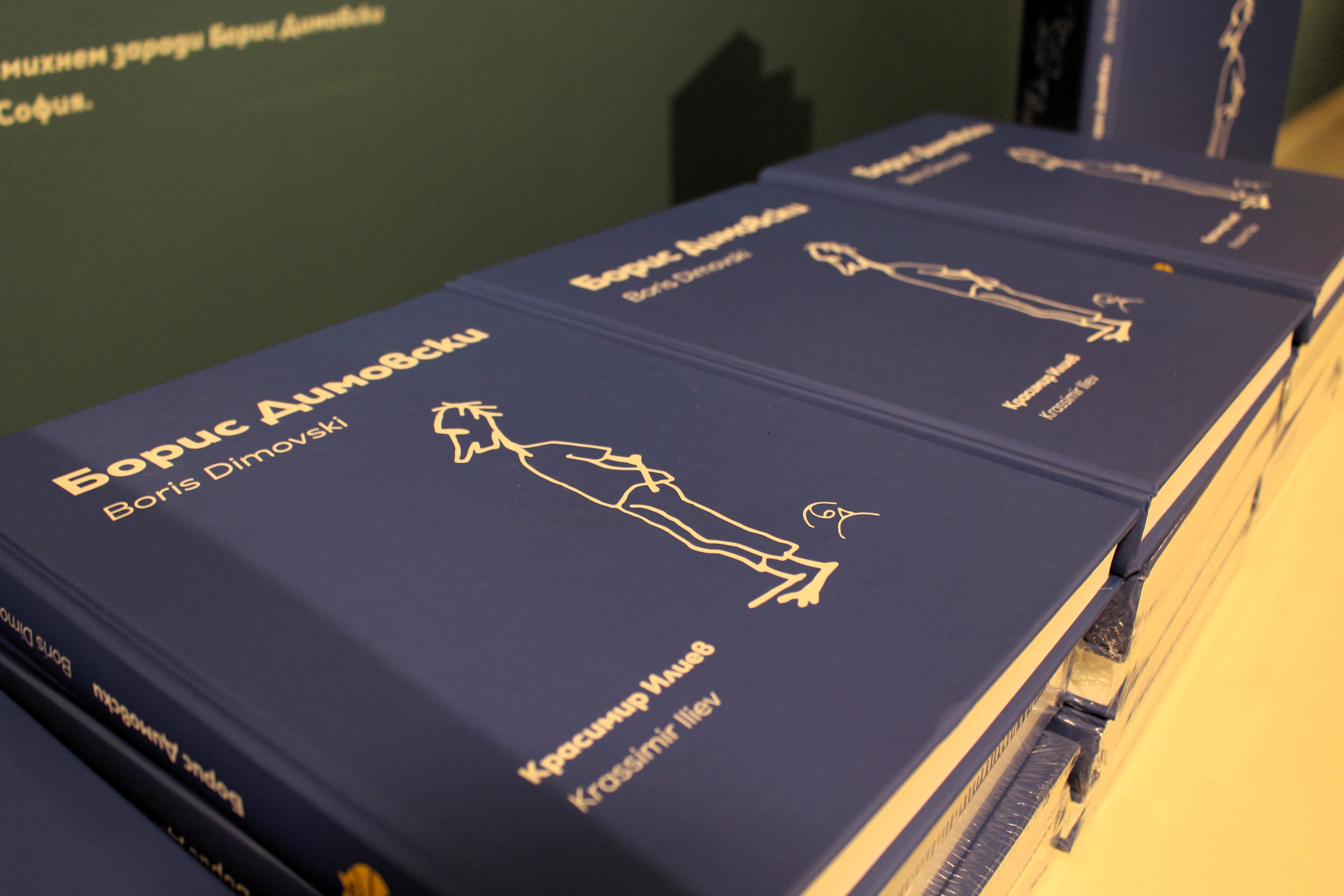
On June 17 at 6:00 PM, we presented the new monograph dedicated to the artist and cartoonist Boris Dimovski.

The publication is the result of in-depth research and is a fitting closing to the retrospective exhibition organized on the occasion of the 100th anniversary of the artist’s birth.

The event was attended by the deputy director of the museum Nela Rachevits, the author of the book Krassimir Iliev, and the designer Ana Radkova.

Among those present were members of the editorial and translation teams, representatives of cultural circles, the mayor of Gabrovo Municipality Tanya Hristova, and numerous citizens.

In her welcome address, Nela Rachevits highlighted the significant place of Boris Dimovski both in the history of the museum and in the cultural life of Gabrovo.

“This is a worthy publication for our museum. Few institutions in our country would cope with such a serious, profound and large-scale work on Boris Dimovski. His work and his connection with Gabrovo deserve such a study,” she said.

According to her, the publication is the result of a thorough study by the author in close cooperation with the museum team, public institutions, the artist’s family, researchers and collectors, including work with archival documents, correspondence, publications and other materials related to the artist. She added that the monograph is a logical continuation of the retrospective exhibition dedicated to Dimovski.

For his part, Krassimir Iliev shared that the creation of the monograph was a real professional challenge, and emphasized the key contribution of the museum team to the successful implementation of the project.

Currently, those interested can purchase this luxury edition in the store of the Museum of Humor and Satire.


Presentation of the monograph “Boris Dimovski”Presentation of the monograph “Boris Dimovski”

June 17, 2026 (Wednesday)
6:00 p.m., free admission
Museum of Humor and Satire, Gabrovo


On the last day of the retrospective exhibition “Boris Dimovski – 100 Years of Birth” we invite you to the presentation of the monograph “Boris Dimovski” – the work of Krasimir Iliev, curator of the exhibition.

The Museum of Humor and Satire and the author worked on the creation of this work with the conviction that the publication will contribute to the preservation and popularization of the artist’s creative heritage and his deep connection with Gabrovo – a city that in 1983 awarded him the title of “Honorary Citizen”.

The book contains 340 pages and over 600 images of caricatures, illustrations and photographs. It offers an in-depth look at the life, work and public role of Boris Dimovski – an artist whose name remains inextricably linked to our city.


Boris Dimovski is not only one of the most significant Bulgarian cartoonists, but also among the people who, together with Stefan Furtunov, are at the heart of transforming Gabrovo humor into a cultural symbol recognizable far beyond the borders of Bulgaria. His images and ideas continue to live on in the symbols of the city and in the history of the museum.

Come and meet the author Krasimir Iliev – the man who dedicated a year to return Boris Dimovski to his deserved place in the history of Bulgarian art.


Monograph team:

Author: Krasimir Iliev
Design: Ana Radkova
Editor: Emilia Voleva
English translation: Nevena Ekimova
Translation editor: Tracy Speed
Send feedback

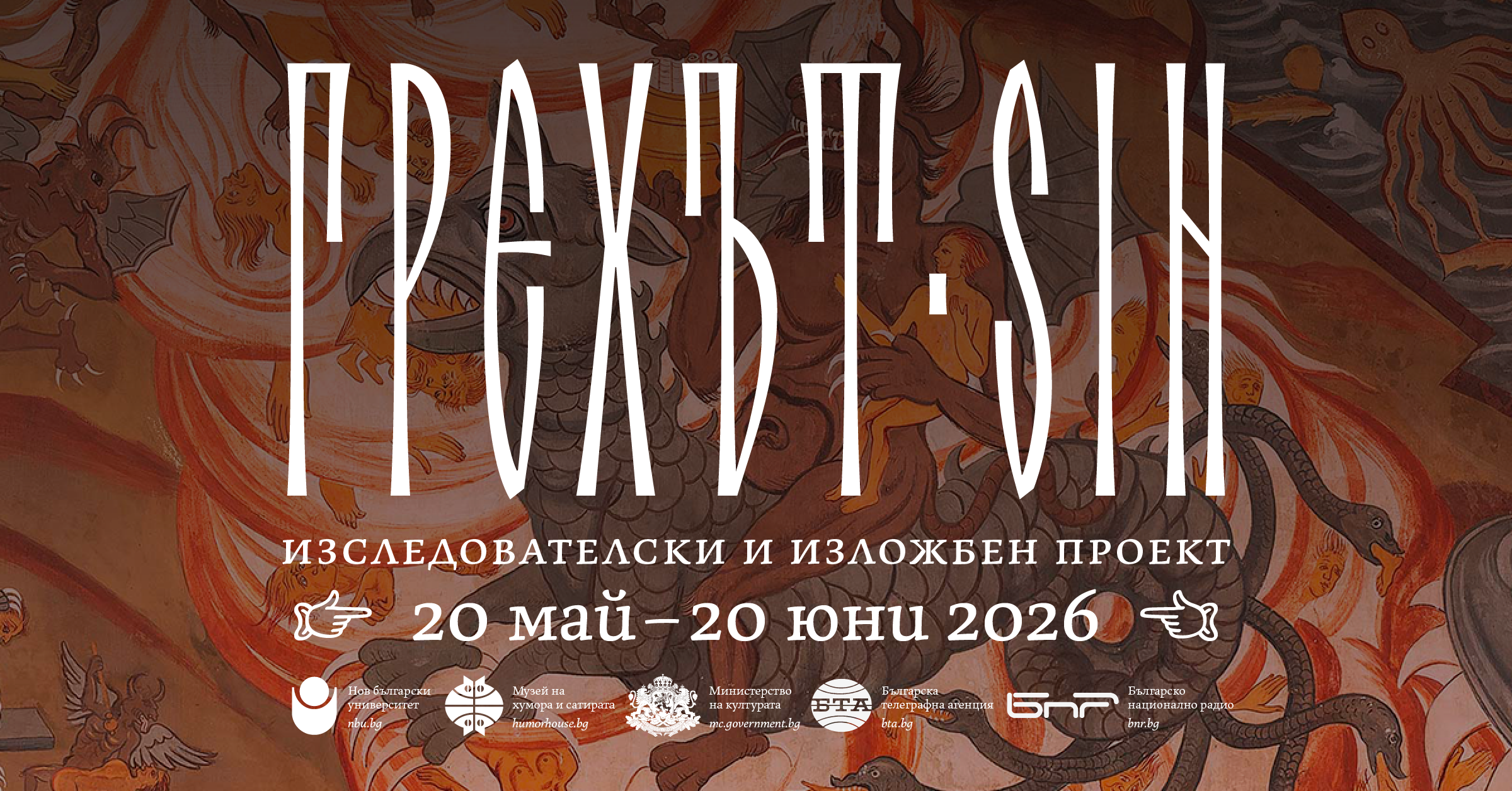
SIN – Research and Exhibition ProjectSIN – Research and Exhibition Project

May 20 – June 20, 2026

The Alley in Front of the Aula, New Bulgarian University, 21 Montevideo St., Sofia

Host Vladimir Dimitrov


What does sin look like?

In images, symbols, fears and moral warnings preserved in the frescoes of Bulgarian medieval and Renaissance churches.

From May 20 to June 20, 2026, the Alley in Front of the Aula of NBU will host the exhibition “Sin” by the House of Humor and Satire in Gabrovo.


The exhibition presents scenes from the Last Judgment, the tolls of the soul and moral-didactic compositions in Bulgarian church painting from the 18th–19th centuries.

Through the images of sinners, demons, artisans, sorcerers and allegorical characters, the exhibition reveals how icon painters transformed painting not only into a religious image, but also into a means of moral education, social criticism and spiritual warning.

The exhibition draws attention to the rich visual language of Orthodox art, in which the fear of sin, the idea of ​​retribution and the hope of salvation are intertwined with humor, the grotesque and clearly recognizable human images.


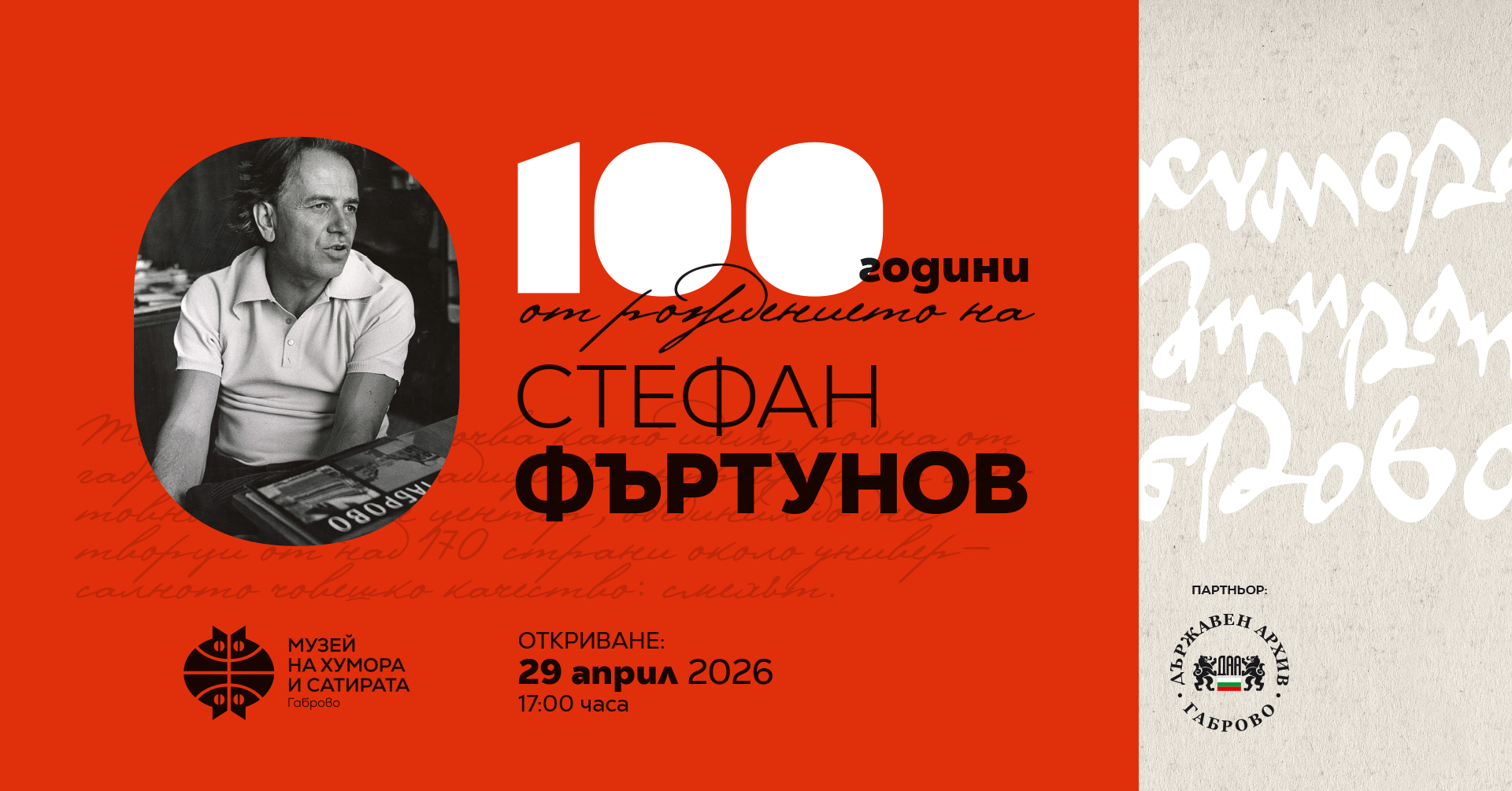
100TH ANNIVERSARY OF THE BIRTH OF STEFAN FARTUNOV100TH ANNIVERSARY OF THE BIRTH OF STEFAN FARTUNOV

Exhibition in the Park of Humor
Opening: 29 April 2026, 5:00 PM


The Museum of Humor and Satire celebrates the 100th anniversary of the birth of its founder, Stefan Fartunov, with an outdoor documentary exhibition located in the Park of Humor.

Under the motto “Laughter Cannot Be Homeless”, the exhibition follows the life and work of the individual who transformed Gabrovo’s humorous tradition into an institution of global importance.

Born on 29 April 1926, Stefan Fartunov was a lawyer by education and a visionary by vocation. He graduated in law from Sofia University and worked as
legal advisor at the Municipal People’s Council in Gabrovo. At the same time, he was actively engaged in cultural activities as Deputy Chairman of the
Aprilov–Palauzov Community Centre and Secretary of the Club of Cultural Workers.

A key moment in his work was the publication in 1966 of the Gabrovo Jokes book, compiled by him, with illustrations by Boris Dimovski and edited by Radoy Ralin. In the years that followed, the book became an international symbol of Gabrovo humour, with over 2,400,000 copies published and translations into more than 20 languages.

Inspired by this tradition, Fartunov went on to create and establish a cultural institution unique in character—the House of Humor and Satire. Together with like-minded people—Mihail Mihov and Veselin Vassilev—he developed the conceptual model for the future institution in the period 1968–1972.
A circle of bright personalities formed around him, including Radoy Ralin-the author of the motto “The world lasts because it laughs.” Boris Dimovski-an artist and cartoonist whose illustrations, murals, and souvenirs became the visual identity of the House; Todor Tsonev—author of key concepts for its name and spatial design—and Bogdan Benev, creator of its emblematic logo. Crucial support was provided by architect Karl Kandulkov, then Mayor of
Gabrovo and also the author of the architectural design, under which an industrial building began its transformation into the House of Humor and Satire in 1972.

The First Biennial of Humor and Satire was held in 1973, and on 17 May 1975 the building was officially opened. In a gesture true to the institution’s spirit, the facade was temporarily “wrapped” and decorated by Boris Dimovski with illustrations from Gabrovo Jokes.

Over the following decades, the House established itself as an international centre for humour and satire. In 1980, during the 21st session of UNESCO’s
General Conference in Belgrade, the institution was officially admitted to the UNESCO network as an international information centre for humour and
satire—a unique status of its kind in the world.

Stefan Fartunov was awarded the title “Distinguished Cultural Figure” and the Order of Saints Cyril and Methodius, First degree. In 2003, he was awarded the title of “Honorary Citizen of Gabrovo” for his outstanding contribution to the city’s cultural life.

Since 2015, a representative hall in the Museum of Humor and Satire has been named after him.

Stefan Furtunov died on June 25, 2010 in Gabrovo, leaving behind an institution that lives and laughs even today.

The exhibition presents archival documents, photographs, and testimonies related to the creation and development of the House of Humor and Satire—a story of vision, consistency, and the power of a cultural idea.

“True humor knows no borders—it crosses them and becomes the heritage of all people around the world.” (Stefan Fartunov)


The exhibition is realised in partnership with the State Archives – Gabrovo.
Special thanks for their support to the Municipality of Gabrovo and the Municipal Enterprise “Urban Development”

PUSTA VE4NOST / BLANK ETERNITYPUSTA VE4NOST / BLANK ETERNITY

The Museum of Humor and Satire presents:
PUSTA VE4NOST / BLANK ETERNITY
Exhibition by Filip Boyadzhiev

April 1 – June 30, 2026
Floor 2, Giraffe Hall


The exhibition BLANK ETERNITY by visual artist Filip Boyadjiev explores the mechanisms through which contemporary social images transform into cultural mythologies. The project continues the line of theconTEMPORARY HEROES series, in which the author works with the figure of the so-called “traditional bulgarian man” – a character that is both familiar and hyperbolized, constructed from various layers of post-socialist culture. This figure emerges as a kind of hero of our time – a self-proclaimed patriot who builds his own symbolic universe from signs of status, power, and belonging.

The central element is a spatial installation composed of thousands of empty metal cans, forming a monumental environment reminiscent of a sanctuary. This space can be interpreted as a temple, built by the hero himself as an attempt to leave a trace and secure his presence in eternity.

The forced encounter between two cultural models – Bulgarian pseudo-patriotism and ancient Egyptian tradition – creates a distinctive clash. The archetype of eternity is refracted through the local context and turns into a grotesque form, where the desire for grandeur mixes with an element of absurdity. The temple that the hero constructs is both monument and stage set – a space in which the aspiration for immortality is marked by its own irony.

In the exhibition, the hero dissolves into a system of objects and symbols. Fragments of everyday life function as cultural markers that shape a visual vocabulary of a hybrid identity attempting to stand simultaneously in the past, present, and future. The black color covering the objects in the installation functions as a final gesture of intervention by the artist. The shine of the symbols is absorbed and neutralized; the objects become silhouettes devoid of individuality. Thus, the desire to shine turns into a gesture of self-extinguishing, the pursuit of greatness transforms into an image of one’s own emptiness, and the hero’s ego gradually becomes grotesque.


After its highly successful presentation in Sofia, the exhibition moves to Gabrovo – a city that, in the Bulgarian cultural context, is closely associated with traditions of humor, self-irony, and social critique. Presenting the project at the Museum of Humor and Satire creates a new context of the work, which is not simply a re-presentation of the exhibition but its conceptual continuation. The encounter between the project and the specific cultural environment of Gabrovo highlights the role of humor as a tool for critical thinking – the ability of society to recognize its own mythologies and question them.

The metal cans were provided with the kind assistance of Elena Tsvyatkova.

This project is realised with the financial support of the Ministry of Culture.

“Structures in Transition” – Curatorial School 2.0 Exhibition“Structures in Transition” – Curatorial School 2.0 Exhibition

Opening: 24.03.2026 at 1:30 p.m., Fourth floor, Museum of Humor and Satire

The exhibition “Structures in Transition” (24 March – 25 July 2026) is the culmination of the two‑month Curatorial School – an educational and practical program aimed at developing curatorial skills, critical thinking, and professional preparation in the field of visual arts.  

Within the context of the Bulgarian art scene, curatorial work often remains ambiguous. The initiative of the Christo and Jeanne‑Claude Center in Gabrovo seeks to create a sustainable framework for learning, collective practice, and public presentation. The school gives its 18 participants an opportunity for interdisciplinary collaboration – an approach inspired by the combination of different kinds of knowledge and experience characteristic of Christo and Jeanne‑Claude’s projects.  

Hosted by the Museum of Humor and Satire in Gabrovo, “Structures in Transition” is organized in three thematic sections, curated by three working groups mentored by Margarita Dorovska, Svetlana Kuyumjieva, and Vesela Nozharova. The participants also had the opportunity to consult with the lecturers Vasil Vidinski and Stanimir Stoyanov.

The exhibition includes works from the museum’s archive, brought into dialogue with the perspectives of young painters, contemporary artists, illustrators, and even photojournalists. The project explores the tension between the individual and society, revealing the many invisible ties and rules that connect them.  

Its three sub‑themes are “The Queue,” “The Game,” and “Taming the Monument.”

“The Queue” examines a familiar social phenomenon that speaks volumes about different historical periods – their shortages, needs, and aspirations. A line of people waiting for something is a democratic and self‑regulating structure, yet it can easily become a monument to passivity or a vicious circle. Group “The Queue”: Ivana Borisova, Maria Borisheva, Yoshka Mihaylova, Iva Rudnikova, Krastina Stefanova, Emilia Stoeva 

Taking as its starting point the local case of Chardafon in Gabrovo – a monument whose head was replaced by those in power more than once – “Taming the Monument” investigates the “beheading” of monuments both literally and metaphorically: as the end of an ideological narrative and as a process revealing public memory as a field of continual rewriting. Every monument has an ideological lifespan. Group “Taming the Monument”: Hristina Decheva, Martina Grueva, Ivelina Ivanova, Kalina Ivanova, Teodora Marinova, Marina Kisyova de Heus

“The Game” segment, inspired by Johan Huizinga’s concept of Homo Ludens (“the playing man”), looks at play not only as entertainment or an escape from reality but also as a fundamental principle through which a society understands, constructs, and resists the world. The works presented analyze the mechanisms of (dis)empowerment that shape our reality, leaving room for experimentation and a reconsideration of the rules by which we live. Group “The Game”: Paola Dimova, Aleksi Ivanov, Natalia Krisenko, Ekaterina Leondieva, Ralitsa Petkova, Ana Radkova, Elena Tsvyatkova 

“Structures in Transition” runs until 25 July 2026 at the Museum of Humor and Satire in Gabrovo.  

Participating artists: Zhenya Adamova, Velko Angelov, Zhivko Angelov, Ivo Bistrichki, Tsvetomira Borisova, Veselin Borishev, Lachezar Boyadjiev, Panayot Barnev, Anna Vasof, Alexander Valchev, Ivan Grigorov, Damyan Damyanov, Petra Dimitrova, Angelariy Dimitrov, Evgeni Dimitrov, Stefan Ikoga, Hristo Komarnitski, Veselin Kostadinov, Ivan Landzhev, Roxana Markova, Yoshka Mihaylova, Ivan Moudov, Stefan Nikolaev, Alina Papazova, Adrian Paci, Nia Pushkarova, Kamen Stoyanov, Isao Hashimoto, Veronika Tsekova, Valko Chobanov, Venelin Shurelov, Geri Georgieva


Curatorial School 2.0 is a project by the Christo and Jeanne‑Claude Center and Plakat Combinat Ltd., funded under procedure BG‑RRP‑11.021, Grant Scheme “New Generation of Local Cultural Policies for Major Municipalities,” Investment “Development of Cultural and Creative Sectors,” Component “Social Inclusion,” National Recovery and Resilience Plan.


Brieftopia: Art Between Crisis and ImaginationBrieftopia: Art Between Crisis and Imagination

21 March 2026 – 30 June 2026

First International Laboratory for the 26th Gabrovo Biennial of Humour and Satire in Art

Participating artists:
Voin de Voin, Nevena Ekimova, Armando Lulaj, Ivan Moudov, Maria Nalbantova, Behzad K. Noori, Boryana Petkova, Antoni Rayzhekov, Lexi Fleurs, Luka Cvetković

Curator: Snejana Krasteva
Museum of Humour and Satire, Gabrovo


The Museum of Humour and Satire presents the project Brieftopia: Art Between Crisis and Imagination – the first international laboratory in preparation for the upcoming 26th edition of the Gabrovo Biennial of Humour and Satire in Art (2029). The project features a group exhibition showcasing newly commissioned works, including performance, video, film, interactive installations, and workshops, created specifically for the laboratory by international and Bulgarian artists.

The term “Brieftopia” is a neologism combining brief and utopia. Introduced by Iranian-Swedish artist and researcher Behzad K. Noori (a participating artist and co-curator of the next Gabrovo Biennial together with Snejana Krasteva), it describes a fleeting yet powerful form of utopian imagination oriented toward an accessible and tangible future. As Noori writes, it is “a brief moment in which art intertwines with the politics of imagining plausible futures, in order to envision a tangible future that offers temporary refuge and potential paths for navigating existence.”

Brieftopia functions simultaneously as a critical working method and a research approach, drawing on one of the key hard-won privileges of contemporary art—its freedom—in order to resist what Mark Fisher has termed the “slow cancellation of the future.” According to Fisher, we live in an era in which every fragment from the past can return like a zombie, where cultural differences lose their specificity, and where the present stretches into an endless presentism marked by a pervasive sense of hopelessness toward the future.

Brieftopia, however, thrives precisely between hope and hopelessness—as a form of hopeless optimism, of insistence without illusion. “It is not about believing that things will work out, but about refusing to abandon the act of imagining the future, even after belief has been exhausted” (Noori). Art offers a space in which alternative models of co-existence can be tested on a smaller scale, where operations on time can be performed (stretching, compressing, looping, stopping, reversing, or fast-forwarding it), and where essential mental processes—abstract and concrete thinking alike—can be freely “practised” through bodily and sensory experience.

Brieftopia: Art Between Crisis and Imagination marks the first step toward the 26th edition of the Gabrovo Biennial of Humour and Satire in Art, an established forum for contemporary art in Bulgaria and the region, to be curated by Snejana Krasteva and Behzad K. Noori. Through an open, multi-stage, and context-sensitive approach, the project aims to strengthen Gabrovo’s role as an active centre for contemporary art and international cultural exchange. The laboratory will include a series of events, curatorial tours, and workshops, as well as a two-day international symposium on 23–24 May 2026, featuring distinguished speakers such as philosopher Boris Buden, political scientist Francisco Carballo, artists, writers, and researchers Magnus Bärtås, Edgar Shmitz, and Snejanka Mihaylova, among others.

More about the project “Brieftopia: Art Between Crises and Imagination”: https://humorhouse.bg/briftopiabg/


The project is realised with financial support from procedure BG-RRP-11.021, New Generation of Local Cultural Policies for Large Municipalities, Investment Development of Cultural and Creative Sectors, Component Social Inclusion, National Recovery and Resilience Plan.
FANGIRLFANGIRL

Solo Exhibition at Museum of Humor and Satire

Curator: Reneta Georgieva

January 16 – February 16 2026


In the exhibition FANGIRL, Nevena Ekimova undertakes a personal and artistic gesture of return – to herself, to the past, to the men who inhabited it.

The project functions as a kind of emotional retrospective, in which the artist traces the threads of her feelings – attraction, idealization, shame, anger, sadness, ecstasy – towards figures from reality and fantasy, mostly male. It is an intimate but sharply ironic archive of her experiences as a woman and an artist, placed at the heart of fandom – this deeply feminine, often devalued, but also powerful form of identification and projection.

Having crossed the symbolic threshold of 40, Nevena unfolds her artistic language – drawing, sculpture, textiles, speech and music – to map the inner territory where archetypes and personal memories mix like souvenirs: from the father as the first object of adoration and psychological formation, through the fleeting idols of adolescence and adulthood, to the gallery of men and boys she looked up to and fell in love with, who she was disappointed by and who she fantasized about.

The exhibition collects emotional trophies from experienced and untold stories, archives them visually, turning them into an intimate mythology.

FANGIRL is not just an exploration of the desires that the female point of view gives rise to – it is a frank admission of the artistic dependence on these desires, on fixation, on longing.

Something between a teenager’s diary and a mature artistic confession. Nevena allows herself to be both serious and self-ironic, vulnerable and controlling, a fan and an author – and it is precisely in this tension that her artistic maturity is revealed.


Nevena Ekimova is a Bulgarian artist, currently based in her hometown of Gabrovo.

She studied contemporary art in Norway and Iceland, and got her BFA at the Valand Art Academy in Gothenburg, Sweden.

Since 2021, Nevena Ekimova has been working at the Museum of Humor and Satire.

Besides participating in exhibitions, she often works with public institutions and creates large-scale interactive projects for children and adults.

https://nevenaekimova.com


Waiting for the EuroWaiting for the Euro

Location: 3th floor lobby

Starting today, December 10, the Museum of Humor and Satire presents a mini-exhibition of cartoons in which currency is not just money, but a promise of adventures – economic, political and emotional.


What do we know about the introduction of the euro?

Probably as much as we know about the future: few facts, many wishes and a pinch of fear of the unknown.

Will we manage? Will the price of doner kebab increase? Will we become poorer or simply richer in subjects for jokes?

Cartoonists have had an answer for a long time – in their world, the euro is a hero with character, sometimes with a sense of humor, sometimes with a slightly arrogant expression, but always with good intentions.

If we ask economists, the benefits are like in a fairy tale: fewer risks, more stability, easier trade, more efficient markets and a chance to compete with the big players in the world economy without having to worry about exchange rates.

If we ask the artists, the benefits are even clearer: the bigger the currency, the bigger the palette for humor.

This mini-exhibition walks through all of this – the facts, the fears, the hopes and the sheer pleasure of looking at the economy with a smile.

The Eurozone may be a serious club, but the cartoon reminds us that the best way to enter it is with a sense of humor.


The exhibition features cartoons by:

Alla and Chavdar Georgievi, Bulgaria

Wolfgang Schlegel, Germany

Ivan Kutuzov, Bulgaria

Iliyan Savkov, Bulgaria

Manuel Serrano, Spain

Svetlin Stefanov, Bulgaria

Stoyan Dechev, Bulgaria (the cartoon used as the photo for this article)

Florian Doru Crihana, Romania

Chavdar Nikolov, Bulgaria