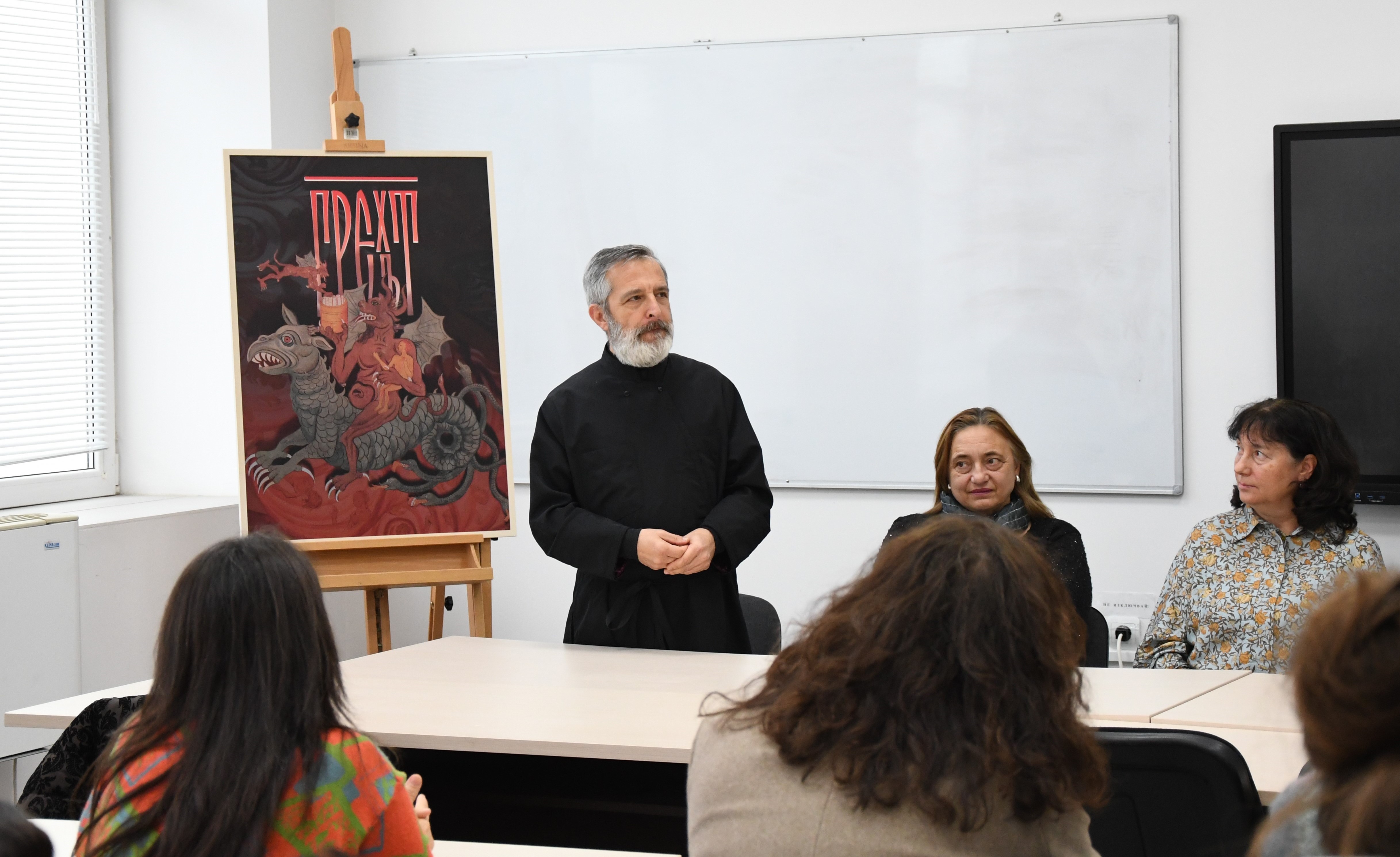
The Mobile Exhibition “SIN” was opened at the Orthodox Theological Faculty of the University of Veliko Tarnovo The Mobile Exhibition “SIN” was opened at the Orthodox Theological Faculty of the University of Veliko Tarnovo

On December 4, in the hall “Prof. Dr. Lyuben Prashkov” of the Veliko Tarnovo University “St. St. Cyril and Methodius”, the mobile exhibition “Sin” of the Museum of Humor and Satire – Gabrovo was presented.
The event was held by invitation and in partnership with the Orthodox Theological Faculty, which hosts the exhibition.
The opening was attended by the Vice-Rector of the University, Prof. Dr. Vihren Buzov, the Dean of the Orthodox Theological Faculty, Prof. Dr. Magdalena Legkostup, deputy deans, lecturers, students, artists and iconographers – which placed the exhibition in a clearly academic and professionally contextualized framework.
The collection, presented under the title “Sin”, includes a total of 50 copies of frescoes and icons related to the theme of sin, made in the 1970s by a team led by art historian Asen Vasiliev. This team also included Professor Lyuben Prashkov – a fact that makes the exhibition of the collection in the hall bearing his name particularly significant.
In Veliko Tarnovo, 28 exhibition pieces presented information about the collection of copies, field studies to locate the originals and interpretations by experts on the subject. The selection makes it possible to trace different visual approaches to the motif of sin in Orthodox art – from stricter moral scenes to those in which elements of criticism, irony and a satirical attitude towards human weaknesses are clearly present. A particularly important context for this collection is the fact that a significant part of the originals from which the copies were made are today severely damaged, altered or inaccessible. Therefore, the copies acquire the value of a visual document and represent a key source for the study of specific mural cycles and iconographic solutions from the second half of the 20th century.
During the presentation, the deputy director of the Museum of Humor and Satire Nela Rachevits outlined the chronology of the creation of the collection and its study 50 years later. The beginning was set in the 1970s at the idea of the satirist and cartoonist Todor Tsonev, who drew attention to the satirical and comical in Bulgarian Renaissance art. On this basis, the museum team began to purposefully search for murals in various temples and monasteries in which reality – and in particular transgressions – are presented in a critical, sometimes grotesque manner.
In 2024, after a team from the Christo and Jeanne-Claude Center’s curatorial school began working on an exhibition related to the collection, the museum took the next step: it became clear that in addition to the collected copies, a contemporary narrative was also needed to connect them with today’s audience. Therefore, work on the collection resumed, now with a focus on additional documentation, analysis, and preparation of a future permanent exhibition.
The current stage of the project is being implemented with funding from the Ministry of Culture in 2024. The goal is to build a comprehensive package of materials – archival documents, photographs, expert texts, and field observations – that would serve as the basis for restructuring the presentation of the collection at the Museum of Humor and Satire. Rachevitz emphasized that plans were underway to renovate the museum building, rethink the tourist flow, and create a special space in which the Sin exhibition will be displayed in a permanent format.
The head of the field research for the project, curator Ilina Peneva, presented to the audience the specific steps in the team’s research work. Within the framework of the project, numerous temples and monasteries in the country were visited, where the condition of the original frescoes, changes in the interior of the temples and the reasons for the loss of certain images were monitored. Peneva emphasized that in a number of places the originals are missing entirely or are severely damaged, which makes the available copies not just “reproductions”, but a real basis for reconstructing the visual history of these frescoes. This material is also the basis for decisions on how to exhibit the panels – in a way that preserves the connection between the historical context, the research data and the perception of the modern audience.
The Dean of the Faculty of Orthodox Theology, Prof. Dr. Magdalena Legkostup, congratulated the museum team for the consistent work on the project and noted that the inclusion of a theologian in future stages would contribute to an even more complete analysis of the presented scenes and inscriptions. She also drew attention to the possibility of using the exhibition in the education of students of theology, Church history and Christian art. Father Dr. Teodor Enchev, who participated in the symposium (September 2025) related to the project, placed the collection in the context of the time in which it was created – the period of communism. He emphasized that some of the best specialists worked on the copies, and the dimensions and compositions follow the originals with high accuracy. According to him, these images clearly show both the condemnation and ridicule of sin –
humor and grotesque, which the artists of the Bulgarian National Revival used boldly and freely.
In the discussion after the presentation, the participants defined the project as an extremely valuable resource for specialists and for all those who work in the field of visual heritage, church history and cultural heritage. The exhibition “Sin” has already been shown in Dryanovo and is about to continue its journey to other cities and institutions. As part of the long-term work on the project, a bilingual monograph is planned to be published in early January, uniting the images and research texts of experts from various fields. By the end of the year, a specialized website is also expected to be launched, where a significant part of the collected materials will be available.
“Sin – a research and exhibition project” is realized with the financial support of the Ministry of Culture, in partnership with the VTU “St. Cyril and Methodius” and the Municipal History Museum in the town of Dryanovo, and the media support of the Bulgarian National Radio Program and BTA.