On November 21, the Museum of Humor and Satire joins the national Reading Day initiative with its own cheerful edition – in our museum library!
Throughout the day, every visitor is invited to stop for a moment, reach for a book and share the joy of reading – with texts that make us laugh.
You can expect:
– A treat from the golden fund of humor – excerpts from favorite authors, read by the library team and guests during the day;
– A pinch of laughter to the daily menu – a corner with books and jokes with aphorisms, epigrams and jokes;
– Reading – a healthy dessert for the body and soul – time for a photo with a selected book.
On your way out, share your impressions on the flipchart board in the library to leave the best sign that reading is worth it.
When: November 21 (Friday), all day
Where: Library of the Museum of Humor and Satire, Gabrovo
The third National Reading Day – Bulgaria will take place this year on November 21.
The initiative follows the German Reading Day and from 2025 is synchronized with the European Authors’ Day Read. for Real.
For another year, the event is organized by the Reading Foundation, the Children’s Books Foundation and the Books and Reading Association.
Anyone can participate – schools, kindergartens, libraries, community centers, families, individual readers, institutions, organizations and businesses.
Anyone can get involved by registering for participation and dedicating time for free reading or by organizing readings, discussions and other initiatives.
The main motivation of the organizers is to focus attention on overcoming functional illiteracy — according to PISA 2022, 53% of 15-year-olds do not understand what they read, which also affects the development of the environment and undermines democratic principles.
We were visited by sixth grade students from the 11th Secondary School “Raicho Karolev”, Gabrovo.
Help us restore the first souvenir line of the House of Humor and Satire!
The idea of creating Gabrovo humor souvenirs arose with the establishment of the House of Humor and Satire more than 53 years ago.
Back in the 70s, prototypes of everyone’s favorite cups appeared, designed by Boris Dimovski – cup halves for Gabrovo “coffee for two”, a stingy sugar bowl, a spoon with a hole, a coffee cup with a glued saucer, a cup for coffee divination, etc.
In 1980–1981, the cartoonist, together with the master of artistic ceramics Nedyalka Kolcheva, further developed and enriched the first souvenir series – witty, humorous and entirely in the spirit of Gabrovo.
Today, 45 years later, we are looking for the missing pieces in order to professionally photograph them and include them in a slideshow for the exhibition “Boris Dimovski – 100-year Birth Anniversary”.
The following souvenirs from the series (1980–1981) are wanted:
Ceramics:
Cup with saucer – set
Teapot, sugar bowl and cup halves set
Coffee, tea and milk set (the teapot has 3 spouts – one for each drink)
Bowl with ornaments (two versions)
Cylindrical vase with relief decoration of a cat
Cup – candlestick
Tile “Gabrovo 81” – face with mustache and inscription
Tile “Gabrovo 81” – cat with inscription
Tile “Gabrovo 81” – female profile
Other materials:
T-shirt with tie – designer model based on a drawing by Dimovski
Wrapping paper and fabric “Made in Gabrovo”
*Below in the gallery you can see what the sought-after souvenirs look like visually.
How you can help
If you keep any of these souvenirs:
Bring it to the Museum of Humor and Satire (68 Bryanska St., Gabrovo) to have it professionally photographed;
it will be returned the same day or the next.
Or send a photo and a short note (when and where the object is from) to press@humorhouse.bg
You can get more information by calling 0884028581
Each object is part of Gabrovo’s memory and brings the smile of its time.
Why we do it
The collected images will be included in a slideshow for the exhibition.
Thus, together we will restore the first souvenir line of the Museum – a project that in 1980 marked the beginning of our visual identity.
Deadline: December 10, 2025
Museum of Humor and Satire, Gabrovo
Cup with saucer – setCup – candlestickBowl with ornaments 1Bowl with ornaments 2Teapot, sugar bowl and cup halves setCoffee, tea and milk set – the teapot has 3 spoutsCylindrical vase with relief decoration of a catTile “Gabrovo 81” – cat with inscriptionTile “Gabrovo 81” – Super CatTile “Gabrovo 81” – cat and mouseT-shirt with tie “Made in Gabrovo”Wrapping paper and fabric “Made in Gabrovo” 1Wrapping paper and fabric “Made in Gabrovo” 2
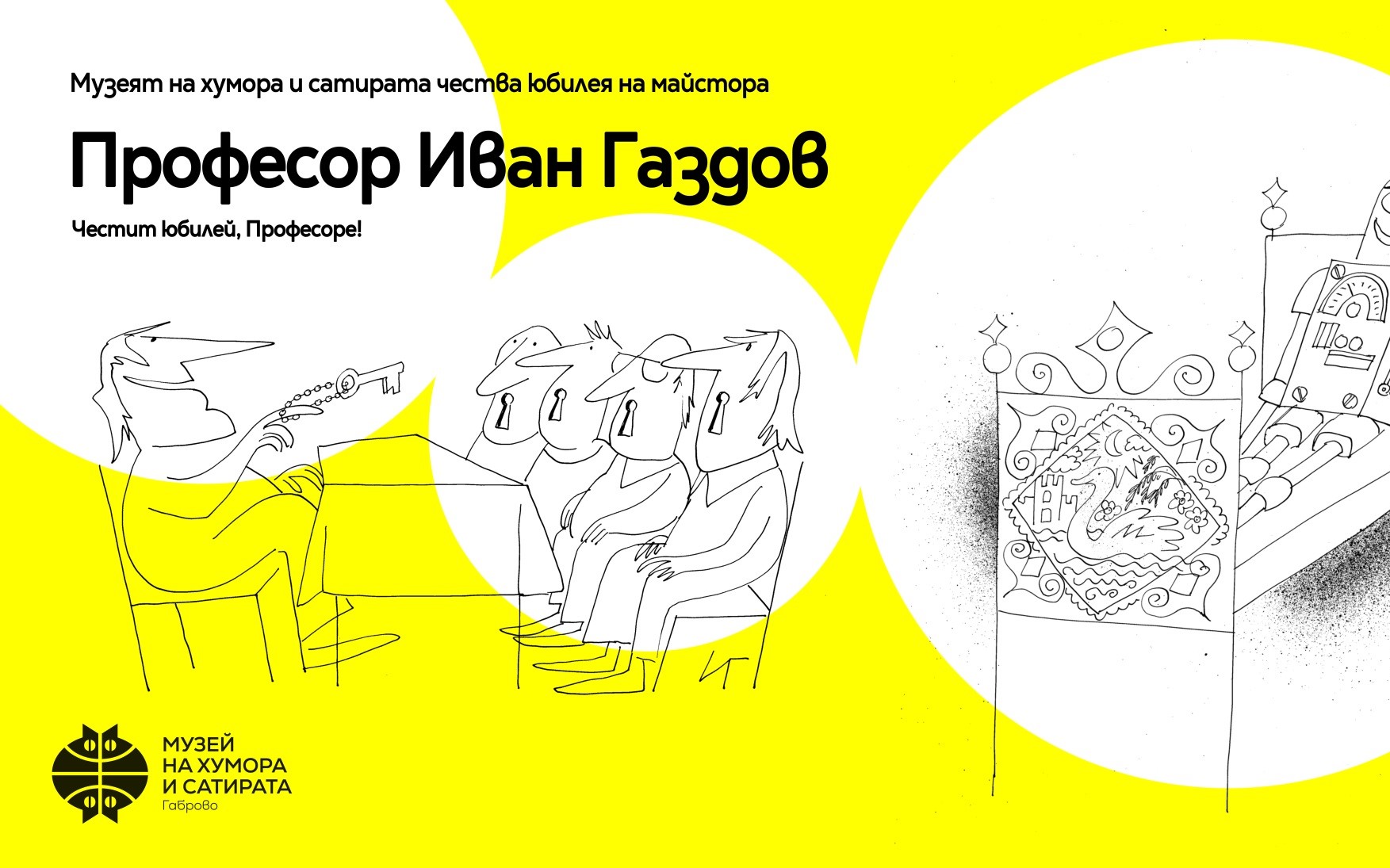
On the occasion of the anniversary, the Museum of Humor and Satire presents selected works of his in the lobby in front of the library on the third floor.
Professor Ivan Gazdov was born on November 2, 1945 in the city of Yambol.
He graduated from the Art High School in Sofia in 1964 and the National Academy of Arts “Nikolai Pavlovich” in 1970.
Since 1973, he has won a competition for a part-time assistant in the specialty “Poster” and is a teacher at the oldest and most prestigious school of fine arts in Bulgaria.
Ivan Gazdov’s career is associated with systematic work in the field of creating high-quality products in the field of fine arts and intelligent teaching.
For more than 50 years, he has been responsible for the development of creative flair and professional innovations in several generations of Bulgarian artists.
In the period between 1999 and 2003, Ivan Gazdov was the rector of the Academy.
He is the creator of the “Author’s Poster” school in Bulgaria, as well as his own patented style – “Graphicature”.
He works in the field of graphics and graphic design, is the author of several monographs on the poster and numerous articles in the specialized press. He is the winner of numerous awards.
A lot of humor and irony are “woven” into his work. Humor is not understandable by everyone, irony and self-irony – even less so. But still, humor is hope. Art that does not give you hope, that does not inspire you, is the art of hopelessness.
Prof. Gazdov’s ties with the Museum of Humor and Satire began from its very inception. He was a participant in the First International Biennial of Humor and Satire in 1973 in a total of 12 editions of the competition.
Over the years, his donated works to the museum have become an important part of the collection.
We have presented three solo exhibitions of Prof. Gazdov – the first with 50 illustrations to Radoi Ralin’s book “Laugh, Executioner (Clown)” in 1982, “Graphic Art” in 1995 and “Black Touches. A Tribute to Graphic Art” in 2018.
*The photo below is from the album “20 Years of Graphic Art, Ivan Gazdov; The Mystery of Graphic Art by Maria Landova; 101 Selected Works”, which you can view in the museum library.
On October 27, 2025, a Symposium on the “Sin” project was held in the library of the Museum of Humor and Satire – a key event in the preparation of the new permanent exhibition, which will restore and rethink the presentation of the emblematic museum collection, exhibited in the Museum from 1975 to 2022.
About the Project
“Sin – Research and Exhibition Project” focuses on the unique museum collection of 50 copies of frescoes from 16 churches and monasteries in Bulgaria.
Its goal is to support the team in developing a narrative about the collection that is understandable to a modern audience – from field and archival research to interpretive solutions, design and communication with the public.
The corpus of images offers artistic, ethnographic, historical and moral-philosophical layers, putting sacred art, satire and contemporary interpretations of moral themes into dialogue.
Participants and Topics
The symposium brought together curators, art historians, theologians, psychologists, museum specialists, artists and teachers, who presented their analytical texts and research and discussed.
The meeting took place in a spirit of in-depth dialogue and shared commitment to the topic of the collection and contemporary approaches to its presentation – considered not only in a theological, but also in a cultural, social and aesthetic context.
Event facilitator: Margarita Dorovska – Head of the Fine Arts and Exhibition and Fund Activities Department at the museum and author of the project concept.
Authors of the analytical texts:
Prof. Dr. Raina Gavrilova – cultural scientist and historian, Sofia University “St. Kliment Ohridski” Dr. Vladimir Dimitrov – art historian, NBU Dr. Slava Yanakieva – cultural scientist and theologian, NBU Svetoslav Stoev – psychologist and social analyst Tchavdar Nikolov – cartoonist and visual satirist Tatyana Tsankova – ethnologist and long-time director of the museum Ilina Peneva – curator and PR, Christo and Jeanne-Claude Center, Gabrovo (results of field research) Sava Hristov – project manager, manager of Vidima Gallery, Sevlievo
Results and next steps
The event laid the foundations for the meaningful and interpretative process that will shape the new permanent exhibition “Sin”.
The presented reports and discussions will be used in:
Finalizing the exhibition concept Preparing the accompanying monograph Creating a mobile exhibition Developing a project website
The video documentation from the symposium will support the work of the curatorial team in the next stages of the project.
This project is implemented with the financial support of the Ministry of Culture.
Photo with books from the library of Museum of humor and satire
Over the past two months a team from the Museum of Humor and Satire conducted and processed six interviews with Bulgarian humorists from various fields – cartoonists, writers, actors.
The conversations are part of the museum’s commitments as an associated partner in the international project HUMLIT, which began in early 2025.
The participants were asked 22 questions prepared by the entire Project Advisory Commitee team (participants from Poland, Romania, Estonia, the Czech Republic, and Spain).
The main goal was to explore the production of humor and its perception by the audience.
How did you start creating humorous content? Are there any topics that you consider unacceptable in humor? What general knowledge does the audience need to have to appreciate your humor? What is the role of humor in society today and will this change in the future?
These were some of the questions answered by the part of voices of Bulgarian humor – from different generations and genres – and share their experience, philosophy, and mission: Veselin Zidarov (cartoonist and writer), Svetlin Stefanov (professional artist, cartoonist, and woodcarver), Vesel Tsankov (humorist writer and editor on the Humor and Satire team at the Hristo Botev program of the Bulgarian National Radio), Dimitar Ivanov-Kapitana (puppet and stand-up actor, ventriloquist), Alla and ChavdarGeorgievi (freelance artists and cartoonists, co-founders of the newspaper Pras Press), and Tsvetelina Tsvetkova (freelance writer and humorous content creator).
Below you can read selected quotes from their responses – sincere, thought-provoking and inspiring.
The processing of the interviews for the purposes of the study continues at the moment.
About HUMLIT Project
A key objective of HUMLIT is to understand how humor creation and humor literacy can be used to reframe conflicts and controversial issues in the public sphere and benefit European society by promoting dialogue rather than conflict.
The project is funded by the European Union’s Horizon Europe research and innovation programme and supported by the Marie Skłodowska-Curie Actions. It involves 25 partner academic and non-academic institutions from Belgium, Bulgaria, the Czech Republic, Estonia, Finland, Greece, Ireland, Denmark, Kosovo, Norway, the Republic of North Macedonia, Romania, Slovenia, Spain and Poland, with the coordinating institution being the Jagiellonian University in Kraków.
“I have an advantage to the other cartoonists because I deal with both cartoons and aphorisms. Cartoon is in the feminine gender and aphorism is in the masculine (TN: That is so in Bulgarian) and I have married them and I have so many aphorisms. There are tens of thousands of them. And I can extract a cartoon from an aphorism. From the cartoon I can extract the philosophical and make an aphorism.“
Veselin Zidarov
“When I was drawing a cartoons for already three years with two other colleagues who didn’t have the self-confidence of professionals, we met in Bozhentsi (small village near Gabrovo, architectural reserve) and we went to visit Todor Dinov, the father of Bulgarian animation. I told him: “I have a hard time drawing, I make 4-5 sketches until I clarify the idea…” and he went to his studio, because we were in the yard, and took out a tracing paper folded like a fan. And he said: “I make 17 edits.” They were folded like that because back then there was no Photoshop, no computers. So, at least I know from him, he encouraged me not to have a complex about having to make so many edits, that this is a good way to clean everything up and make it perfect.”
Svetlin Stefanov
“When I went to “Shrednoskolsko zname” (a newspaper for the school youth published during the socialist period), Krastyo Krastev, uncle Kaci (Bulgarian writer, humorist), gave me a very important piece of advice. The craft of writing and any sort of creative work is just like doing sports, it has to be practiced continuously. It has to be practiced every day. And with writing, you have to write every day…You have to write all the time. There’s one piece of advice that is recommended that is attributed to different authors. I am not sure who gave it exactly but it said that if you write one page every day, at the end of the year you will have 365 pages. If half of them are good for something, then that’s almost a novel or a large collection of short stories. So, it is important to write continuously, to write every day now. Now a person has what is also called inspiration. Of course, if a person waits for the inspiration to strike, I can tell you from experience, that they will not write anything. So, you have to sit down every day at the same time to create a dynamic stereotype, a habit and you start writing. You may not have anything in your head but you have to sit down, start thinking, start writing some sentences, cross them out, then go back, correct it and somehow the wheel starts turning. “
Vesel Tsankov
“Publishing a satirical newspaper in a tense political environment is a serious mission. Political cartooning helps build a more active civil society. People should participate in political life and determine the future of their lives themselves. When elections come, everyone should go vote, not sit at home or dig in their gardens. The purpose of political cartooning is to provoke and cause reactions. At Pras Press newspaper, we all stand for civilizational, progressive and democratic principles that we share with the general public, and of course there is some missionary work in this.”
Alla and Chavdar Georgievi
“I manage behind this seemingly absurd humor and dialect to say things that I want to say and they sound in a very different way… I have seen reactions, the first signal is laughter at some seemingly simple thing, at some absurd joke, even a vulgar one, and the next moment comes the realization… I can say whatever I want behind this absurd and heavy humor… I don’t think there should be taboo topics. It depends on how they are presented, it depends on how they are written. There are no taboo topics in humor and there shouldn’t be taboo topics in our lives too“
Tsvetelina Tsvetkova
“Well what can I wish for everyone, I wish for them to laugh because laughter is health. If you are sad, when you laugh, the bad things go away. It’s a little bit like when you’re sick and the pain goes away or when you’re angry at something-when you laugh, it all gets better. Humor…humor is a superhero in my opinion. But then again what are superheroes? They are those who manage to save people from evil, from the everyday grind, from reality…from anything, so that they can laugh and never stop laughing because laughter, as they say, will save the world. Or maybe the world lasts because it laughs. It really is like that. It really is. People need to have a sense of humor, to be able to see stuff from a different angle. There are moments when we need to be serious but for the most part…we are a part of this world for an average of 70-80 years, so it’s better to live those years laughing rather than to go through them with frowning expressions and constantly complaining how horrible everything is…”
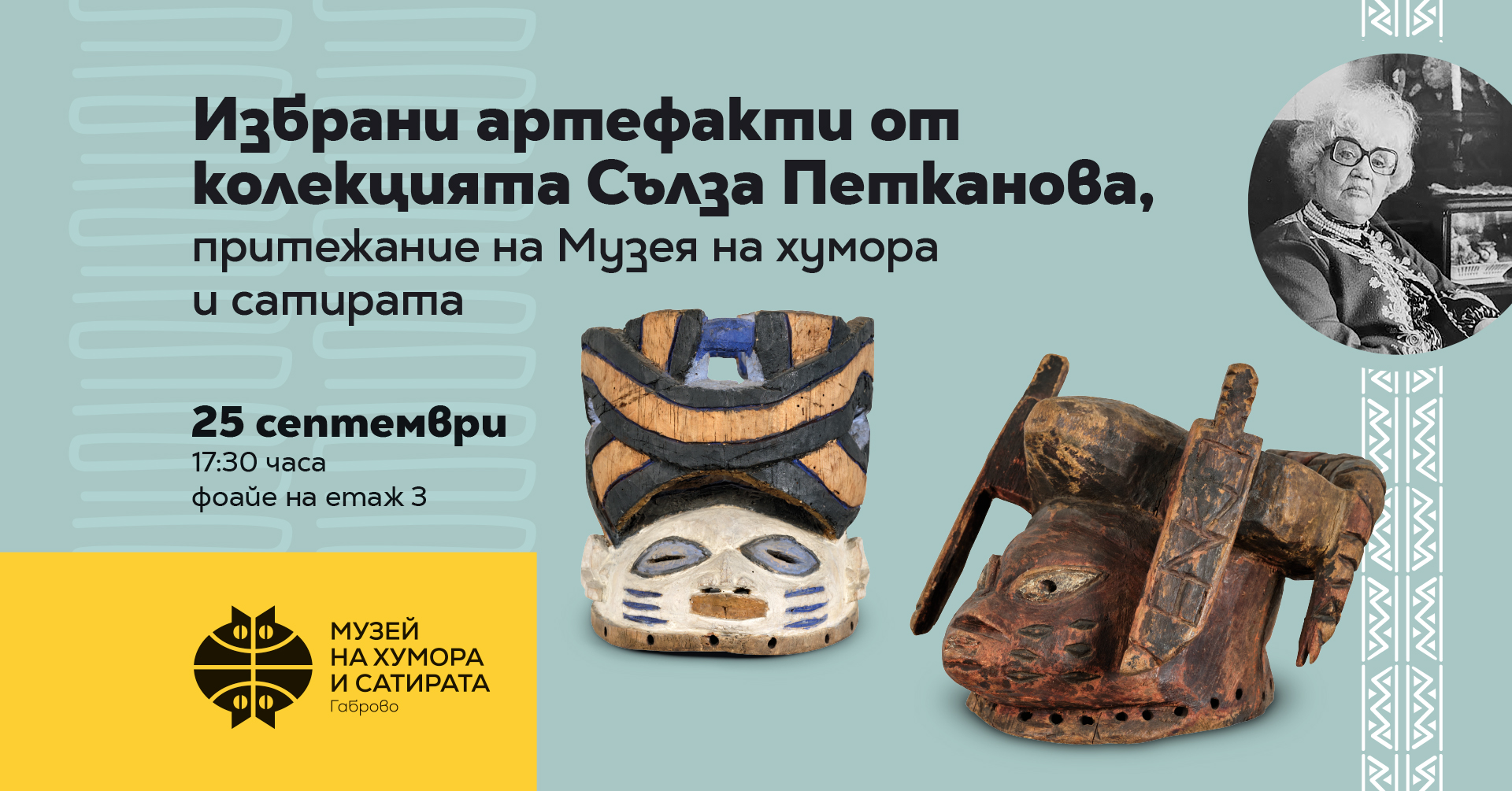
From September 25, the Museum of Humor and Satire presents selected bronze figurines, gold measures and masks, mainly from the 18th and 19th centuries. The unique African pieces are not just exhibits, but bearers of centuries-old wisdom, with which Salza Petkanova introduces us in her books and research. The collection of ritual masks and sculptures is one of the most valuable investments that the Museum has made over the years.
Raised under the wing of writers Konstantin and Magda Petkanovi, Salza Petkanova is a polyglot, philosopher, psychologist, specialist in librarianship and African art. She is the first research associate at the University Library of Sofia University “St. Kliment Ohridski”. In 1965, she was sent as a specialist to Ghana. Later, she became deputy director and subsequently director of the Library of the University of Ghana in Accra, where she spent almost a decade. She returned to Bulgaria with a rich collection of works of African art. A significant part of it is now owned by the Museum of Humor and Satire. For many years, Salza Petkanova was the chairman of the association “Friends of Africa in Bulgaria”.
We invite you to an unusual meeting with 45 beloved and unforgettable Bulgarians. A meeting made possible thanks to Violeta Tsvetkova – a long-time journalist in the field of culture. Her hundreds of interviews, conducted over the years of work for various Bulgarian publications, inspired the creation of the book Alone with the Unforgettables. It brings to life not-so-grumpy old men, ageless favorites, inimitable ladies and unforgettable inspirers – personalities who are no longer with us, but continue to excite generations with their talent and spiritual heritage. Among them are actors, directors, writers, musicians and other cultural figures who have left a lasting mark on Bulgarian memory.
This meeting is even more special for us because it is an occasion to honor one of the people in the book. Her name is Salza Petkanova (1921 – 1997).
Raised under the wing of writers Konstantin and Magda Petkanovi, Salza is a polyglot, philosopher, psychologist, specialist in librarianship and African art. She was the first research associate at the University Library of Sofia University “St. Kliment Ohridski”. In 1965, she was sent as a specialist to Ghana. Later, she became deputy director and later director of the Library of the University of Ghana in Accra, where she spent almost a decade. She returned to Bulgaria with a rich collection of works of African art. A significant part of it is now owned by the Museum of Humor. The collection of ritual masks and figurines is one of the most valuable investments that the Museum of Humor and Satire has made over the years.
This year marks thirty years since Violeta Tsvetkova’s interview with the cosmopolitan Salza Petkanova. This coincidence gives us a wonderful opportunity, along with meeting the charming Violeta and the presentation of her book Alone with the Unforgettables, to show you part of the collection, consisting of small bronze figures, gold measures and masks, mostly from the 18th and 19th centuries. The unique African pieces are not just exhibits, but bearers of centuries-old wisdom, with which Salza Petkanova introduces us in her books and research.
You will hear more about this and other inspiring meetings, about the voices behind the words and about the memories that do not fade – from Violeta Tsvetkova herself.
Come on September 25 (Thursday) at 5:30 p.m. to the Library of the Museum of Humor.
An evening full of stories, spirit and warmth awaits you, which only living memory can awaken.
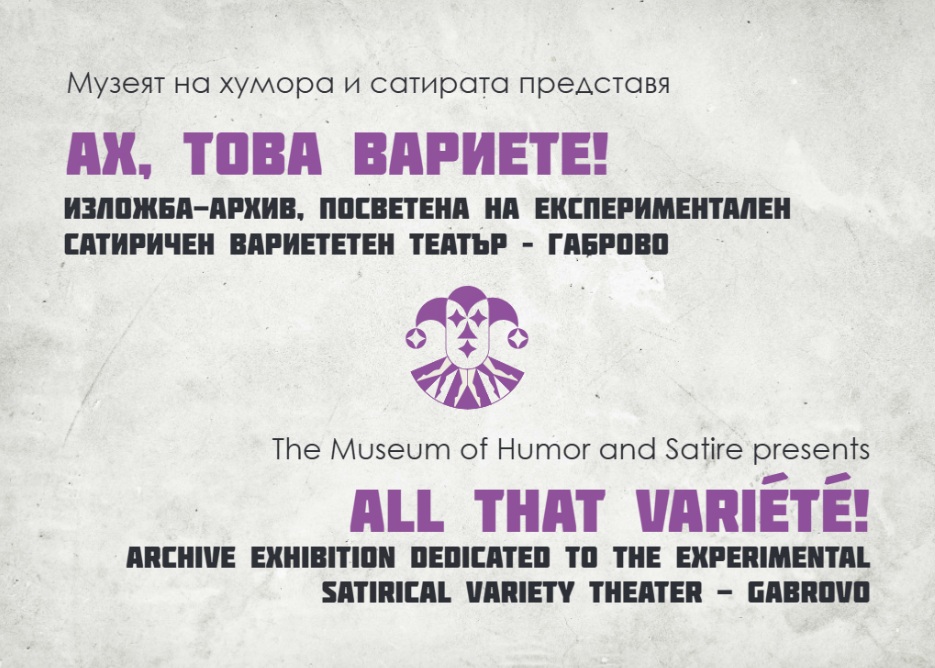
The Museum of Humor and Satire presents All That Variété – an exhibition based on the online archive dedicated to the Experimental Satirical Variety Theater in Gabrovo.
The Variety Theater in Gabrovo is an emblematic institution that existed in the period 1985 – 1999 under one roof with the Museum of Humor and Satire. This year marks 40 years since its opening. Gabrovo residents fondly remember the cozy evenings spent in the characteristic bar atmosphere among talented actors, glamorous costumes, dances and music. Since 2021, the archive has been publicly available online, allowing the audience to follow the history of the theater in detail. This exhibition presents selected moments from the legendary history of the Variété, as everyone called it. The audience will find information about some of the plays performed and meet again with the main characters in this beautiful and somewhat sad tale. Many of these artists – now established actors, directors, choreographers and musicians – began their careers in Gabrovo. The exhibition includes video interviews with some of them, as well as excerpts from performances.
The exhibition can be viewed in halls 6 and 7 on the fourth floor of the Museum of Humor and Satire. The digital archive is available at http://variete.humorhouse.bg/
The Museum of Humor and Satire would like to express its sincere gratitude to the State Archives – Gabrovo and the Aprilov – Palauzov Regional Library for their assistance in collecting archival materials.
The digital archive project was implemented with the financial support of the Ministry of Culture.
Among the artistic directors of the theater are eminent personalities such as Nikolay Nikolaev, Vili Tsankov, Sotir Maynolovski and Nikolay Georgiev. Denitsa Shopova, Nikolay Kipchev, Nona Yotova, Katsi Vaptsarov, Pepa Popzlateva, Teo Elmazov made their acting debut on the famous revolving stage. From the younger generation of artists who played in the Variety Theater are Orlin Pavlov, Yoana Zaharieva and Stefan A. Shterev, and stars such as VG Trik, Nikola Anastasov, Kamelia Todorova, Stefan Mavrodiev and many others have come touring.
Stefan Fartunov Hall Period: August 15, 2025 – January 10, 2026
The exhibition The Bright Side of Life brings together works from the Museum’s art collection and guest canvases by a total of 30 Bulgarian artists, who are meeting for the first time in a specially prepared exhibition. The works presented are constructed through naive expression – one of the most immediate and exciting artistic styles of our time.
For some of the authors, naivety is a main line in their work, for others – a short period, for others – a thread that appears episodically. What connects them is serenity – one of the distinctive features of this style. They almost always choose to see the glass half full.
Naive art entered the world art scene at the beginning of the 20th century – with the jungles of Le Douanier Rousseau and the Artists of the Sacred Heart group in France, with the naive poetry of Niko Pirosmani in Georgia and, a little later, with the canvases of Grandma Moses in the USA. These early paintings were the work of unschooled authors, distinguished by a lacking or distorted perspective, as well as by bright, raw colors, like windows to an instinctive world.
Like any artistic movement, naive art has no strict boundaries or objective criteria for recognition. Nowadays, many of the artists using naive expression have an artistic education and the creation of art is their conscious choice and vocation, and not an intuitive need, as with the first naive artists.
And what does art naive look like today? For us, these are the works that make us smile, sometimes because of the deliberate or completely spontaneous childish ease, sometimes because of the wink hidden in the story, or simply because of the positive mood that flows from the canvases. These are paintings free from academic canons, with a direct expression of feelings, moods, dreams – a flight to a better world, where everything is light, airy, liberated. May the smiles that this exhibition awakens stay with you for a long time – as a sunny reminder of the bright side of life.
The exhibition features: Angel Vasilev, Gancho Karabadzhakov, Georgi Georgiev, Georgi Yordanov, Georgi Panov, Grigor Nechev, Daria Vasilianska, Elisaveta Angelova, Emanuela Bayrakova-Popgencheva, Zdravko Yonchev, Irina Hristova, Kalina Atanasova, Keazim Isinov, Kiril Bozhkilov, Kosta Forev, Lika Yanko, Lyubov Toteva, Lyubomir Minkovski, Lyudmil Mladenov, Mariela Dimitrova – Mara, Nikolay Angelov – Gary, Nikolay Stoev, Radi Nedelchev, Rosen Rashev – Roshpaka, Rumen Gasharav, Stayo Garnoev, Stoyan Bozhkilov, Suleiman Seferov, Todor Pavlov, Hristo Stoychev.
Research and preparation of the exhibition:
Curator: Daniela Osikovska
Fine Art Department, Museum of Humor and Satire Translation: Nevena Ekimova Graphic design: Anton Ivanov, Studio Mozaika Printing of exhibition graphics: Visart