AI is an agency supposedly able to think. But can it laugh? When asked directly, the AI answers: “If making a joke means ‘producing a text that causes a human to laugh,’ then yes. If it means ‘having a sense of humor or understanding why something is funny,’ the answer is currently no.” How to understand it, as a sign of hope, or rather of hopelessness?
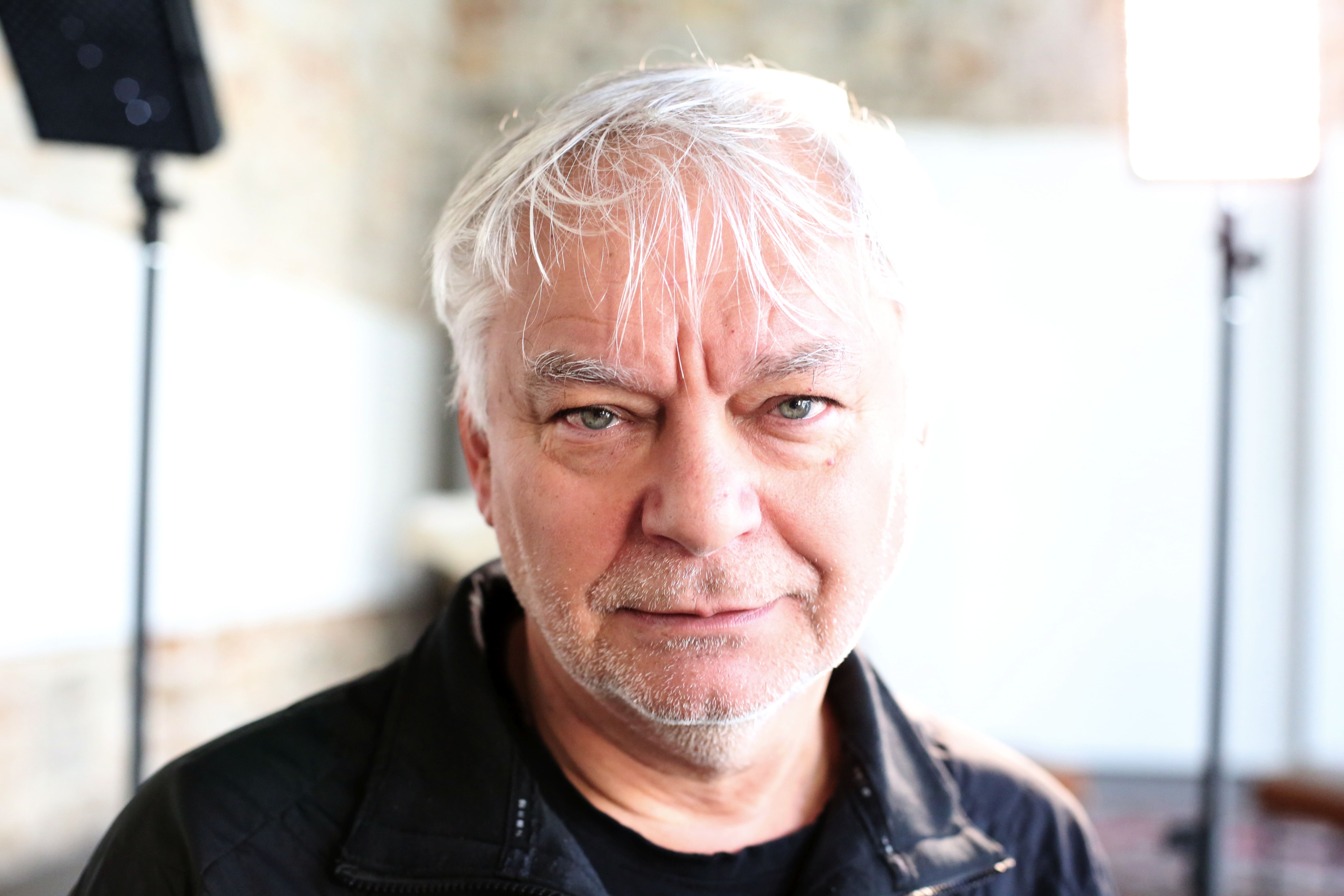
Boris Buden is a writer, cultural theorist, and translator based in Berlin.
Born in former Yugoslavia, he studied philosophy in Zagreb and received his PhD in cultural theory from Humboldt University in Berlin. Since the beginning of the 1980s, Buden has published essays and books on critical and cultural theory, psychoanalysis, politics, and contemporary art in Croatian, German, and English.
Photo: COURTESY OF VLADISLAV TOMIČIĆ
With the support of the Ministry of Culture of Republic of Bulgaria
There’s just over a week left until the “Brieftopia: Archives of Futurity” symposium on 23 and 24 May in Gabrovo, and over the next few days, we’ll introduce you to the speakers who will be taking part—artists, curators, researchers, and thinkers from Bulgaria and around the world.
They will speak about the future, memory, crises, utopias, and those fleeting moments when it seems possible to imagine something different.
In his introductory lecture, artist Behzad K. Noori, who coined the term Brieftopia, describes many facets we have yet to fully discover as closely related to the concept of futurity. Noori situates Brieftopia as both a concept and a method of thinking and practice that emerges from disillusionment yet refuses paralysis. Against the neoliberal capture of the future, far from a symbolic gesture or an emotional retreat into nostalgia, brieftopia is positioned as a practice of surviving failure, proposing a practice of imagination as a lived, fragile, and collective act.
Brieftopia is the final threshold before imagination turns real, often passed unnoticed.
Behzad Khosravi Noori is an artist, writer, educator, and history-teller. His artistic practices include films, installations, and archival studies. His works investigate histories from the Global South, labour and the means of production, and histories of political relationships that have existed as a counter-narration to the East-West, North-South dichotomy.
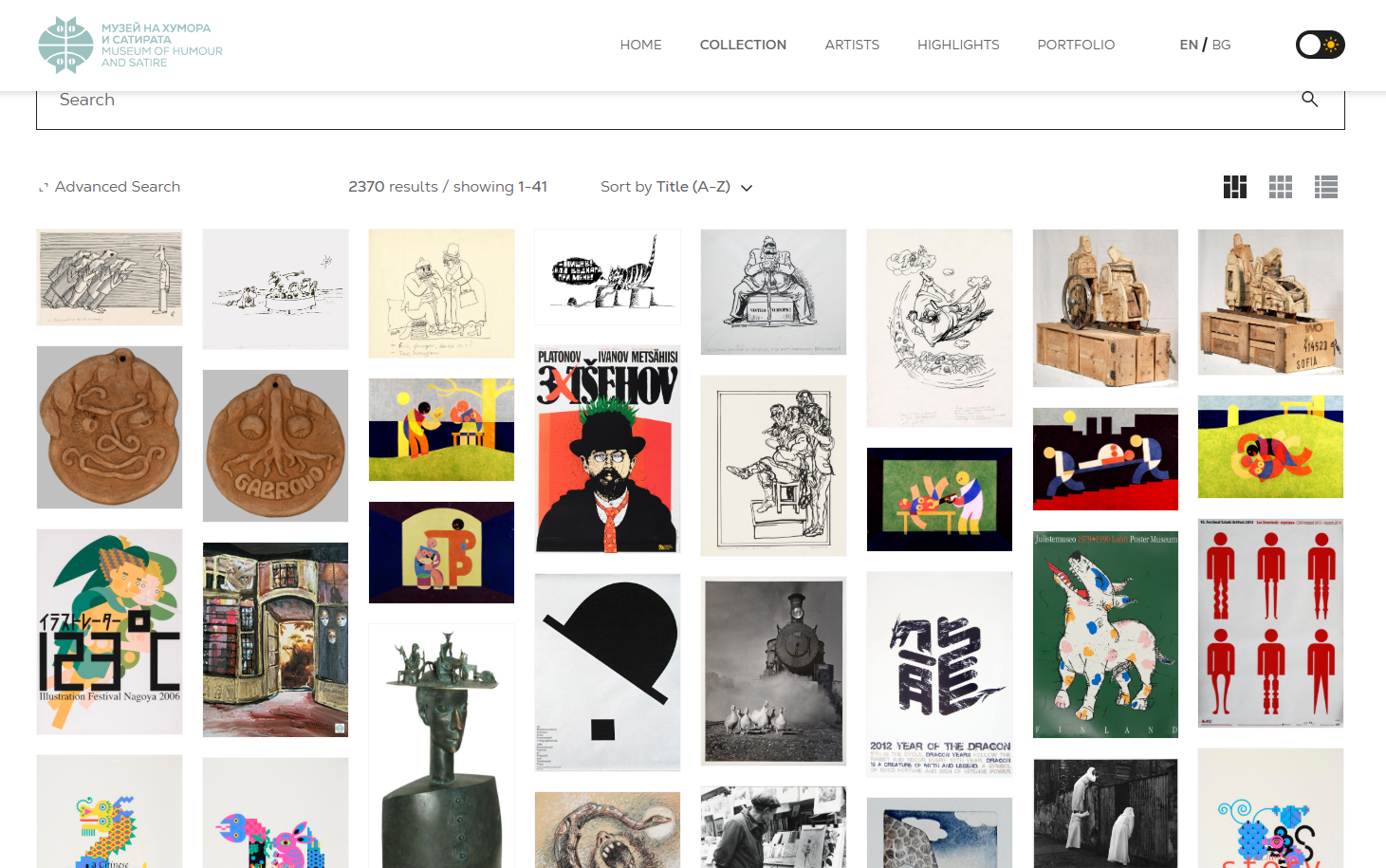
As part of the project “Digital House of Humor and Satire: Art from 170+ Countries over the Last Century”, funded by the National Culture Fund, the Museum has opened public online access to its Collection.
The Digital Catalog is now available here and includes selected works from the Art Collection – Cartoons, Graphics, Paintings, Graphic Posters, Sculptures, Photography and other forms of Visual Art.
The Catalog is updated daily in the process of digitization.
The platform is bilingual (BG/EN) and is built on the MuseumPlus system, implemented in the Museum in 2024.
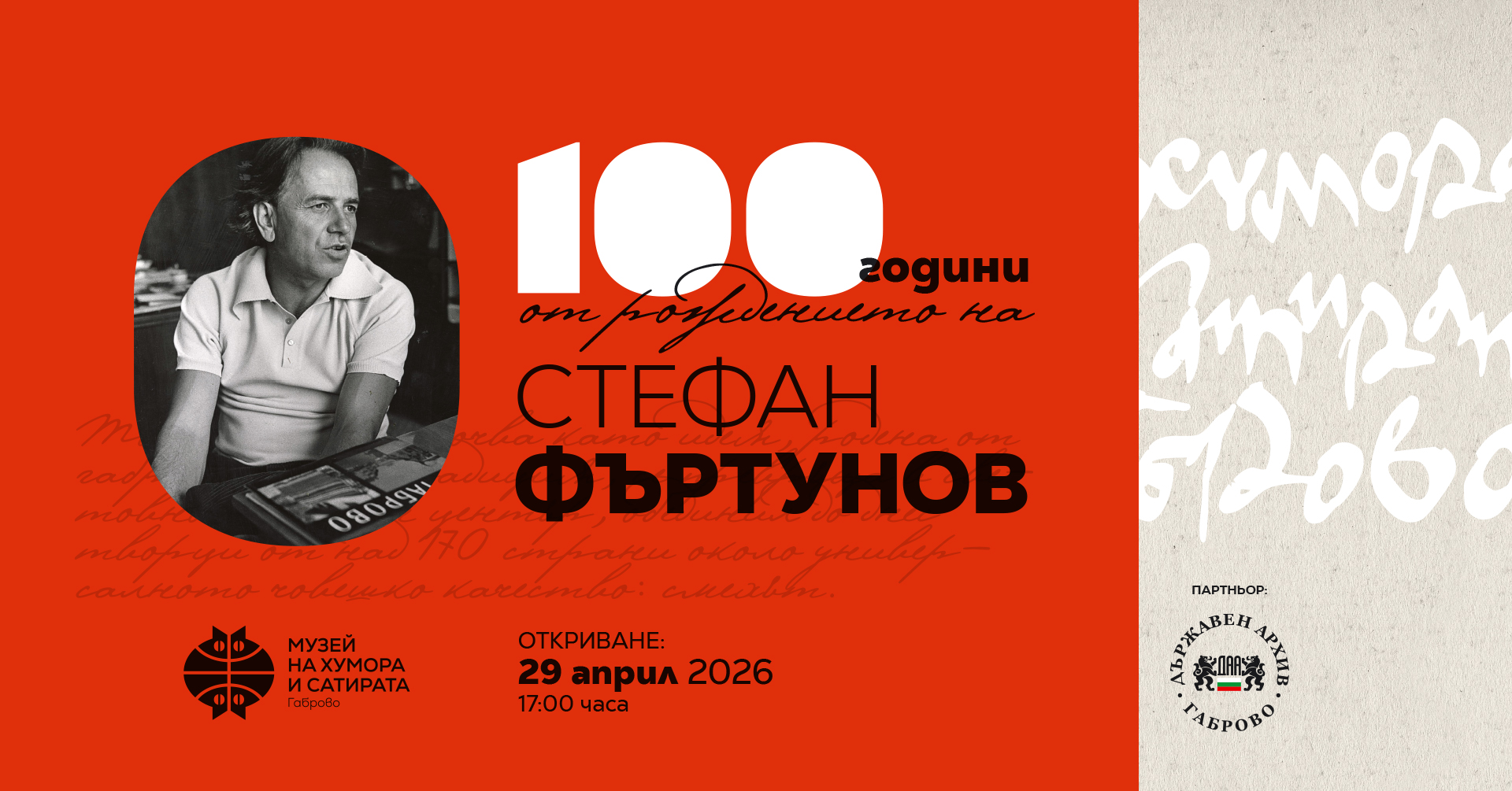
On 29 April 2026, the Museum of Humor and Satire presented the exhibition 100 Years Since the Birth of Stefan Fartunov.
The exhibition is dedicated to the founder of the House of Humor and Satire and traces his life—his personality, work, and significance—while also going beyond biography, as its focus lies on the idea and its realisation rather than on a life story.
Sixteen panels, arranged outdoors near the entrance of the museum, tell the story of a lawyer by training and a visionary of remarkable scale, who over the course of more than twenty years, built and developed an institution without parallel in the world.
The Museum’s deputy director, Nela Rachevits, noted that none of the team working on the exhibition knew Stefan Furtunov personally which made it necessary to adopt a specific approach: to seek understanding through the documents before telling the story. The exhibition is based on in-depth research into archival materials, photographs, publications and audio recordings, among which an extensive interview with Fartunov from the mid-1990s that was told in his own voice and showed his personal narrative. The main goal is to make the content accessible to a wide audience, including passers-by on the street, which is why the exhibition uses visual highlights and short texts. Rachevits emphasized the importance of teamwork and thanked the partners from the State Archives – Gabrovo for their active participation in both the selection of documents and the development of the concept. She also expressed hope that the exhibition would continue to evolve as an ongoing narrative, one to which the Museum will return with each anniversary and for every new generation that seeks to understand where it all began.
Tsvetomira Koycheva, Head of the State Archives – Gabrovo, emphasized the collective character of both the exhibition and the establishment of the museum itself. She mentioned Fartunov’s like-minded collaborators-Veselin Vassilev, Mihail Mihov, Radoy Ralin, Boris Dimovski, and Todor Tsonev-people without whom the House would have remained only a dream. Koycheva also emphasized the importance of the archival materials: only through factual evidence of events and processes can Furtunov’s work be faithfully recreated – and the joint work between the two institutions is precisely the model by which such expositions should be made.
Prior to the official opening, the museum team organised a meeting with former colleagues who had worked with Fartunov. The personal stories they shared complement the archival records and are part of the living memory the exhibition aims to bring forward.
Among the official guests at the event were the Chair of the Municipal Council, Eng. Kliment Kunev, and the Deputy Mayors of Gabrovo Municipality, Maria Yozova and Architect Nikolay Merazchiev.
The Museum of Humor and Satire expresses its gratitude to the partners from the State Archives – Gabrovo, to former colleagues, and to all guests who honoured the anniversary and the work of Stefan Fartunov with their presence – the man who transformed Gabrovo humour from a local phenomenon into a cultural institution of international reach.
The exhibition is realised in partnership with the State Archives – Gabrovo. Special thanks for their support to the Municipality of Gabrovo and the Municipal Enterprise “Urban Development”
The history of Gabrovo is a complex puzzle of events, places, and buildings, shaped by individuals of strong vision.
Among them the remarkable figure of Stefan Fartunov stands out — a man who devoted his energy and time to a bold dream: to establish and develop an institution dedicated to laughter, known as the House of Humor and Satire.
With clarity of vision and unwavering dedication, he transformed Gabrovo’s humorous tradition into a world-renowned centre that brings together artists and creators around a universal human quality — laughter.
We invite you to the opening of an exhibition dedicated to the 100th anniversary of the birth of Stefan Fartunov – creator, organizer and first director of the Museum “House of Humor and Satire”.
The exhibition is realised in partnership with the State Archives – Gabrovo.
Special thanks for their support to the Municipality of Gabrovo and the Municipal Enterprise “Urban Development”
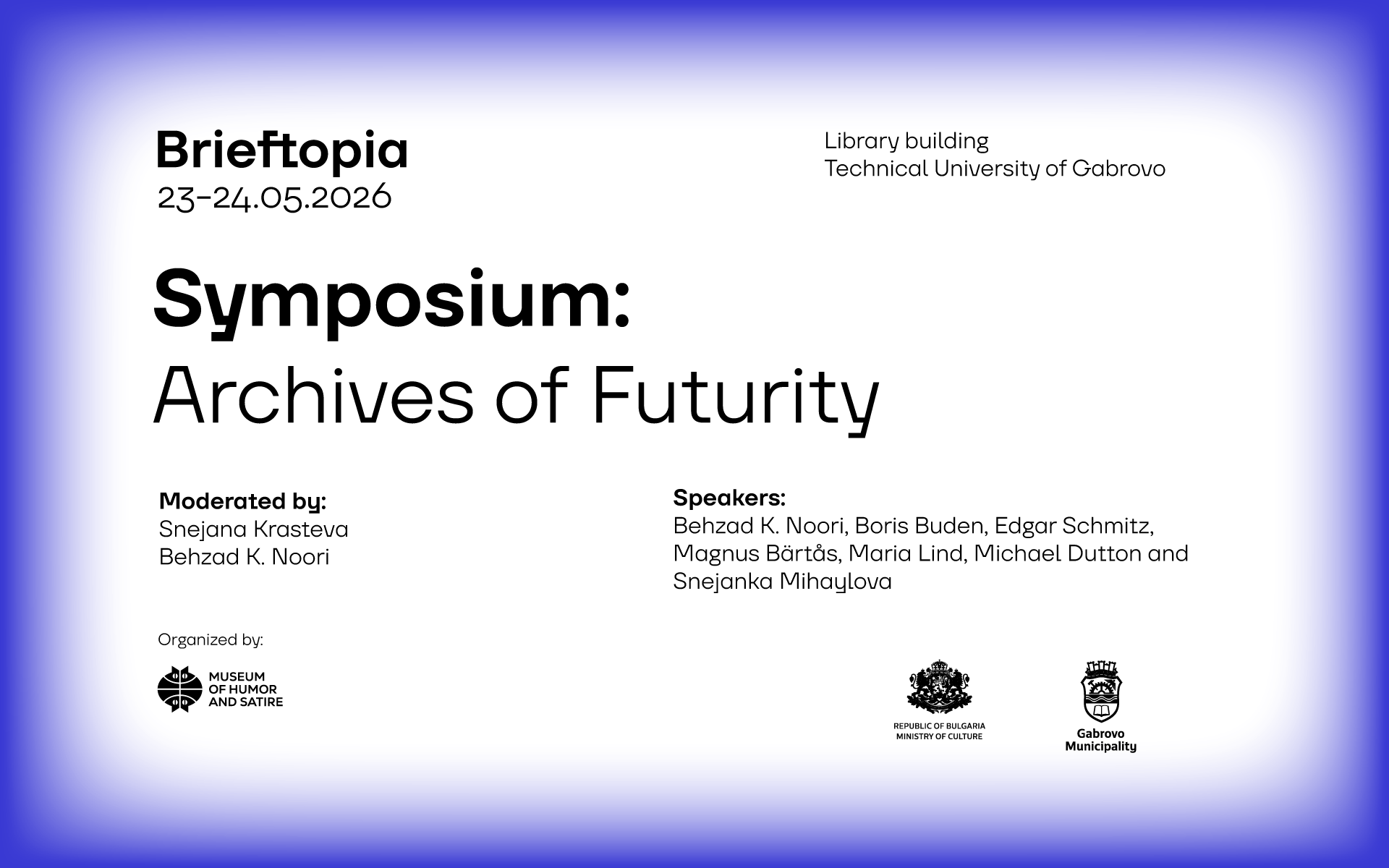
Speakers: Behzad K. Noori, Boris Buden, Edgar Schmitz, Michael Dutton, Magnus Bärtås, Maria Lind and Snejanka Mihaylova
Moderated by: Behzad K. Noori and Snejana Krasteva
Organized by: Museum of Humor and Satire, Gabrovo
Location: Library building, Technical University of Gabrovo, Hadji Dimitar Str N4
In preparation for the 26. Gabrovo Biennial of Humor and Satire in Art 2029, we invite you to take part in the 2-day transdisciplinary Symposium “Brieftopia: Archives of Futurity”.
The Symposium brings together artists, curators, scholars, and researchers from local and international contexts to collectively reflect on the concept of brieftopia, a term coined by Behzad K. Noori to describe fleeting yet tangible utopian moments that emerge within the connection between hope and hopelessness.
The Symposium will take place in relation to the exhibition that opened earlier this year, in March 2026, “Brieftopia: Art between Crisis and Imagination”, which explores hope as a fragile, paradoxical force that persists in direct connection to the imagination. Brieftopia proposes an archive of futurity as a brief moment when imagination and resistance encounter. The Symposium seeks to explore diverse notions of Brieftopian thinking and practices as a method of future investigation that resists monumentalisation.
The Symposium and the Exhibition together are the point of departure for planning the 2029 Gabrovo Biennale, curated by Snejana Krasteva and Behzad K. Noori, positioning Gabrovo as a site for experimental thought on imagination and the precarious politics of futurity. The both initiatives create a collective laboratory for rethinking futurity, and where Gabrovo becomes a site of practice of tangible future possibilities.
Download the Symposium brochure in PDF format >> here
IMPORTANT!
– The symposium will be conducted in English.
— Participation in the symposium is by registration only; space is limited.
– Travel expenses and accommodation are the responsibility of the participants. A preferential rate for accommodation at Hotel Etar (REMO Etar) has been arranged for the duration of the symposium. Please contact the email address below.
– If your plans change and you are unable to attend, please inform us promptly by email at exhibitiondesign@humorhouse.bg
With the support of the Ministry of Culture of Republic of Bulgaria
Symposium Program (*subject to change):
Saturday, May 23, 2026
(optional) *10:00–10:40 Curatorial tour of the exhibition “Brieftopia: Art Between Crises and Imagination” at the Museum of Humor and Satire
11:00–11:15 Arrival of guests at the library 11:15–11:20 Welcome by the Mayor, the Deputy Director of the Museum of Humor and Satire, and the moderators 11:20–12:00 Introduction and lecture by Behzad K. Noоri, “Brieftopia: Archives of Futurity” 12:00–12:40 Lecture by Boris Buden, “Can it laugh? Surviving with AI”
Coffee break 13:00–13:40 Presentation by Snejanka Mihaylova, “Diagonal Thinking” 13:40–14:40 Panel Discussion 1, followed by Q&A, moderated by Snejana Krasteva
Lunch 15:30–16:10 Presentation by Magnus Bärtås, “A Tower Taller Than Myself: a Brieftopian Experiment in a Prison”
16:10–17:50 Presentation by Maria Lind, “How far do we get with moments of magic?” 17:50–19:00 Panel Discussion 2, followed by Q&A, moderated by Behzad K. Noori
Sunday, May 24, 2026 10:00–10:15 Arrival of guests at the library 10:15–10:20 Introduction by the moderator 10:20–11:00 Presentation by Edgar Schmitz, “Trading in Brieftopia” 11:00–11:40 Presentation by Michael Dutton, “Moments of Communism” 11:40–12:40 Panel Discussion 3, followed by Q&A, moderated by Snezhana Krasteva Lunch and screening, followed by a discussion (Q&A) of the film essay “Brioni and Necromantic Theatre” by Behzad K. Noori and Magnus Bärtås 14:00–15:00 Symposium summary, discussion with all participants, followed by Q&A, moderated by Snezhana Krasteva and Behzad K. Noori Free program / organized visits to cultural landmarks in Gabrovo *(optional) Curatorial tour of the exhibition “Brieftopia: Art Between Crises and Imagination” at the Museum of Humor and Satire Visit to the Regional Center for Contemporary Art “Christo and Jeanne-Claude”, Gabrovo; meeting with the Director, Ms. Margarita Dorovska Visit to the Regional Ethnographic Open-Air Museum “Etar”
Synopsis of the lectures and short bio about the speakers (in order of presentations):
Behzad K. Noori, “Brieftopia: Archives of Futurity”
Brieftopia is a fleeting yet tangible encounter with futurity. It is persistence within exhaustion. In my talk, Noori will situate Brieftopia as both a concept and a method of thinking and practice that emerges from disillusionment yet refuses paralysis. Brieftopia is not an emotional retreat into nostalgia or a symbolic gesture, but a practice of surviving failure, a mode of living after defeat. Against the neoliberal capture of the future, where technology and consumption are framed as the primary vehicles of salvation and future, he proposes a critical interruption toward contemporary conditions that reduce futurity to repetition, a managed extension of the present, where imagination is replaced by purchasable images and speculative risk becomes the dominant temporal logic. Brieftopia emerges within this contraction as a counter-practice, proposing imagination as a lived, fragile, and collective act. Brieftopia is the final threshold before imagination turns real, yet it often passes unnoticed.
Behzad Khosravi Noori is an artist, writer, educator, and history-teller. His artistic practices include films, installations, and archival studies. His works investigate histories from the Global South, labour and the means of production, and histories of political relationships that have existed as a counter-narration to the East-West, North-South dichotomy. By bringing multiple subjects into his study, he explores possible correspondences seen through the lenses of contemporary art practice, proletarianism, subalternity, and the technology of image production. He examines contemporary history to revisit memories beyond borders, exploring the entanglements and non/aligned memories.
Boris Buden, “Can it laugh? Surviving with AI”
We don’t need to look much around to realize what a dire situation we are in: chaos, wars, environmental collapse … How to think of the future at a time when pure survival is at stake? Perhaps this is the moment to remember Walter Benjamin, who famously wrote that laughter is the only thing that helps us endure the abyss. He claimed, moreover, that there is no better starting point for thought than laughter.
As it is well known, artificial intelligence has become today an integral part of the reality in which we live. It is more than a new technological tool that might help us to survive. It is an agency supposedly able to think. But can it laugh? When asked directly, the AI answers: “If making a joke means ‘producing a text that causes a human to laugh,’ then yes. If it means ‘having a sense of humor or understanding why something is funny,’ the answer is currently no.” How to understand it, as a sign of hope, or rather of hopelessness?
Boris Buden is a writer, cultural theorist, and translator based in Berlin. Born in former Yugoslavia, he studied philosophy in Zagreb and received his PhD in cultural theory from Humboldt University in Berlin. Since the beginning of the 1980s, Buden has published essays and books on critical and cultural theory, psychoanalysis, politics, and contemporary art in Croatian, German, and English. He is a permanent fellow at The European Institute for Progressive Cultural Policies in Vienna and teaches at various universities in Europe. Recently published: Transition to Nowhere: Art in History After 1989, Berlin 2020.
Snejanka Mihaylova, “Diagonal Thinking”
Is it possible to think something anew, and under what conditions? Hannah Arendt poses this question in the preface to Between Past and Future, a book that serves as an important point of reference for Snezhanka Mihaylova’s lecture in the context of the notion of Brieftopia. The lecture begins with the idea of diagonal thinking, which considers time as a gap or interval.
In parallel, Mihaylova turns to one of her favorite texts by Paul Valéry, Eupalinos ou l’Architecte, a work situated between the creation of a concept and a theatrical play. Socrates and Phaedrus meet after the death of Socrates, or at the end of the time of their own lives, which they perceive as a flowing river. In the movement of the waters, lived experience is reflected through the prism of what has already been written — through Plato’s “Phaedrus”. Thinking emerges as a text within the text, or as an exploration of one’s own relation to the making of meaning. Valéry transforms the experience of understanding into a reversed flow of time, which can be explored as an architectural space.
In a further deviation, the lecture examines and juxtaposes this architectural space of reversed time through specific examples from the work of the Japanese architect Tadao Ando and the island of Naoshima in the Japanese archipelago — a place that has deeply captivated Mihaylova’s imagination. Approaching the subject in the form of a Brieftopic travelogue, the lecture reflects on questions of survival and the return to life after atomic catastrophe. Naoshima appears as an island where multiple scenarios for life after devastation come into being.
The lecture focuses on thinking as a creative practice. Through a series of gaps and deviations, it explores the possibility of art from the perspective of the future and the political promise contained within such a reversal.
Snejanka Mihaylova’s practice is grounded in performance and writing, as well as in long-term artistic research that approaches performance as a form of thinking and inquiry. Central to her work is the understanding that thinking is not solely internal or abstract, but emerges through relational, embodied, and acoustic experiences in acts of listening, voicing, and shared attention. In her recent work, Mihaylova develops the notion of thinking-in-assembly, a practice of collective thought that unfolds through co-presence, voicing, and attentive listening.
Magnus Bärtås, “A Tower Taller Than Myself: a Brieftopian experiment in a Prison”
The prison and the museum may appear as opposites. One is built to hide something, to separate us from something we don’t want to see; the other is built for visibility, to optimise visuality. Historically, these institutions arose at about the same time, and inside the key feature is common: the principle of observing. In the city of Kalmar, in the south of Sweden, there is only 500 meters between the two buildings, and the installation I created during six months together with six inmates establishes a relation between the prison’s confinement and the openness of the museum. The workshops at the prison included art presentations and discussions about crime and punishment, and we came to inspire each other in the construction of a meticulous work that materialises questions of power, surveillance, control, obsession, architecture, violence, and beauty. The whole situation that came about may be described as a brieftopia, a situation that, according to Behzad Khosravi Noori, can be compared with an intermezzo – a sudden opportunity to break a pattern and create something radically different. Brieftopia is driven by a utopian desire but rejects the placelessness that characterises utopian thinking. The work became a temporary refuge from reality and simultaneously something very real, a creation of a strange topography, a city of towers larger than ourselves.
Magnus Bärtås is an artist, writer, professor in fine arts, and head of research at Konstfack, working mainly with text, video, and installation. His dissertation in artistic research, You Told Me – Work stories and video essays, was presented in 2010 at the University of Gothenburg. Hewon the Grand Prize at the Oberhausen International Film Festival in 2010, and in 2024 he won, together with Behzad Khosravi Noori, the 1st prize of the Ministry of Culture and Science of North Rhine-Westphalia at the same festival. His works have been shown at the Gwangju Biennial, Moderna Museet, Stockholm, and Göteborgs Konsthall, among other venues.
Maria Lind, “How far do we get with moments of magic?”
Curator, writer and educator Maria Lind will address the question of “How far do we get with moments of magic?” through presenting and discussing three projects with which she has been involved: The TV Trampoline: From Children’s Television to Contemporary Art and Literature in Moscow, Kalmar, Umeå, Norrtälje and Kiruna, The Silent University by artist Ahmet Ögut at Tensta konsthall in Stockholm and The Benevolent Food in Kiruna.
Maria Lind is a curator, writer, and educator from Stockholm. She is currently the director of the Kin Museum of Contemporary Art, Kiruna. From 2020 to 2023, she served as the counsellor of culture at the Embassy of Sweden, Moscow. She was the director of Stockholm’s Tensta konsthall 2011-18, the artistic director of the 11th Gwangju Biennale, the director of the graduate program, Center for Curatorial Studies, Bard College (2008-2010), and director of Iaspis in Stockholm (2005-2007). From 2002-2004, she was the director of Kunstverein München, and in 1998, co-curator of Europe’s itinerant biennial, Manifesta 2 in Luxembourg.
Edgar Schmitz, “Trading in Brieftopia”
When the here and now is so marked by depletion and erasure that it starts trembling under the pressures of its excessive futures, it tends to strike new bargains with the past and bring the dead back into the shared spaces of now, before and after. Like most future-oriented practices, necromancing animates present, past, and yet-to-be worlds into volatile patterns of exchange.
This is often framed as apocalyptic, but it isn’t in itself that exceptional. Most civilisations (have long had to) trade their futures with the claims of the dead, their gifts and demands, in ongoing negotiations that are culturally mediated, collectively ritualised and individually enacted. To shape and face the future without negotiating it with the past would simply be preposterous in most cases.
(All cultures and civilisations command technologies that allow for zones of contact with the not-now and the not-here in multiple directions. History and storytelling are technologies in this sense; film, love, and emancipatory politics are others, variously enfolding and morphing the temporalities and spacings of available present/ past/ future constellations until they offer up new ways of inhabiting worlds.)
Edgar Schmitz’s architectures, films, and soundtracks are concerned with developing modes of withdrawal, the dispersed materialities of the choreographic, and the temporal shapes of (in-)animacy. His work has been shown in solo presentations at Netwerk Aalst, Shanghai Himalayas Museum, Cooper Gallery Dundee, FormContent and ICA, London, and has featured in A.C.A.D.E.M.Y at Van Abbemuseum, No Soul for Sale at Tate Modern, and the Hayward Gallery’s British Art Show 7, a.o. Schmitz is the founder of the CHOREOGRAPHIC and ANIMATE ASSEMBLY research clusters, curates the Choreographic Devices exhibition series and directs the Art Research Programme at Goldsmiths, University of London.
Michael Dutton, “Moments of Communism”
By shifting the analytical scale from macro-historical “modes of production” to the granular “moment,” this paper explores political life through energy expenditures that fall outside the calculative logic of both capitalism and traditional Marxism. While drawing on Georges Bataille’s recognition of energy flows beyond the working day, the text pivots from his rigid “homogeneous/heterogeneous” binary to employ the Daoist concept of qi (vital energy). This proposes a hydrodynamic ontology where energy is fluid and contoured by context rather than fixed categories.
This framework tracks the redirection of energy toward site-specific “islands of lived experience.” The paper identifies this shift through three manifestations: Otto von Busch’s “justice machine” as a site of collective ingenuity; Walter Benjamin’s passionate book collector, whose singular obsession decommodifies the object; and Michael Asher’s “Water Fountain,” which animates communal tradition through mundane utility. Dutton presents these as specific “agglutinations” that disrupt the technocratic turn in modern social thought, reclaiming the political as a fleeting energy found in the “bits and bobs” of communal life.
Michael Dutton is Emeritus Professor of Politics at Goldsmiths, University of London, and a Fellow of the Academy of the Social Sciences in Australia. A founding co-editor of the journal Postcolonial Studies, his research uses the Chinese archive to challenge the technocratic turn in social theory. From urban street-life to his recent work on the “art of the political,” Dutton’s ‘art’ traces the affective flows through the de-intensifications of market desire through to the material intensities of the everyday. In his 2004 “The Book of Politics: China in Theory,” he follows energy flows from revolutionary kitsch to the Coldspot refrigerator.
Photo Exhibition by Veselin Borisev April 1 – June 30, 2026 Opening: April 1, 2026, 4:30 PM Floor 4, Hall 8
The author of Just Cats doesn’t describe himself as a cat lover. Yet, despite his preference for dogs, cats have always been part of his life. Today, he and his family share their home with two dogs and one cat.
Urban or rural, domestic or free‑roaming, black, white, or multicolored, lazy or restless, aloof or affectionate—no cat appears alone in the photographs of this exhibition. In every portrait, one senses the eye behind the lens: Veselin Borishev watching, observing, connecting. It feels like love.
The photographs in Just Cats belong to a larger, still-unshown project titled Pets and Other Species.
About the author
Veselin Borishev, a Bulgarian photographer born in 1967 and a graduate of Sofia’s National High School of Fine Arts, is renowned for his compelling fine art and photojournalistic work.
His artistry transitions between traditional film and digital photography, utilizing both black-and-white and color to explore varied, always conceptual themes. Rejecting stylistic boundaries, he engages in constant experimentation. His images convey a raw honesty, often brutally sincere.
The Museum of Humor and Satire presents: PUSTA VE4NOST / BLANK ETERNITY Exhibition by Filip Boyadzhiev
April 1 – June 30, 2026 Opening: April 1, 2026, 6:00 PM Floor 2, Giraffe Hall
The exhibition BLANK ETERNITY by visual artist Filip Boyadjiev explores the mechanisms through which contemporary social images transform into cultural mythologies. The project continues the line of theconTEMPORARY HEROES series, in which the author works with the figure of the so-called “traditional bulgarian man” – a character that is both familiar and hyperbolized, constructed from various layers of post-socialist culture. This figure emerges as a kind of hero of our time – a self-proclaimed patriot who builds his own symbolic universe from signs of status, power, and belonging.
The central element is a spatial installation composed of thousands of empty metal cans, forming a monumental environment reminiscent of a sanctuary. This space can be interpreted as a temple, built by the hero himself as an attempt to leave a trace and secure his presence in eternity.
The forced encounter between two cultural models – Bulgarian pseudo-patriotism and ancient Egyptian tradition – creates a distinctive clash. The archetype of eternity is refracted through the local context and turns into a grotesque form, where the desire for grandeur mixes with an element of absurdity. The temple that the hero constructs is both monument and stage set – a space in which the aspiration for immortality is marked by its own irony.
In the exhibition, the hero dissolves into a system of objects and symbols. Fragments of everyday life function as cultural markers that shape a visual vocabulary of a hybrid identity attempting to stand simultaneously in the past, present, and future. The black color covering the objects in the installation functions as a final gesture of intervention by the artist. The shine of the symbols is absorbed and neutralized; the objects become silhouettes devoid of individuality. Thus, the desire to shine turns into a gesture of self-extinguishing, the pursuit of greatness transforms into an image of one’s own emptiness, and the hero’s ego gradually becomes grotesque.
After its highly successful presentation in Sofia, the exhibition moves to Gabrovo – a city that, in the Bulgarian cultural context, is closely associated with traditions of humor, self-irony, and social critique. Presenting the project at the Museum of Humor and Satire creates a new context of the work, which is not simply a re-presentation of the exhibition but its conceptual continuation. The encounter between the project and the specific cultural environment of Gabrovo highlights the role of humor as a tool for critical thinking – the ability of society to recognize its own mythologies and question them.
The metal cans were provided with the kind assistance of Elena Tsvyatkova.
This project is realised with the financial support of the Ministry of Culture.
Humor has a curious ability: the more years it accumulates, the better it sees the weaknesses of the world.
On April 1st 2026, we celebrate 54 years since the founding of the Museum of Humor and Satire with a program full of art, games and the right to believe nothing.
Program
10:00 – 12:00 Children’s workshop “The Tailless April Fool’s Joke”, hall 8, for children from 5 to 10 years old.
11:00 Tour of the exhibition PUSTA VE4NOST with the author Filip Boyadzhiev, Giraffe Hall
13:00 – 15:00 “Fun quest ’26 (for the third time)” – a game for the whole family
15:00 Tour of the exhibition PUSTA VE4NOST with the author Filip Boyadzhiev, Giraffe Hall
16:30 Opening of the photo exhibition “Just Cats” by Vesselin Borishev, Hall 8
18:00 Opening of the exhibition “PUSTA VE4NOST” by the visual artist Filip Boyadzhiev.
Nationalism, pseudo-patriotism and 10,000 empty cans — dedicated to the “traditional man”, Giraffe Hall
Throughout the day you can also:
participate in the “True and False Facts About Cats” challenge
make your own Internet meme
draw inspired by the work of Boris Dimovski, Hall 4
leave your wish for the Museum birthday in the Guest Book
Entrance is free.
54 years is a wonderful age – wise enough to doubt the seriousness of the world, and young enough to laugh at it.
We are looking forward to celebrate our birthday with you!