We continue our introduction of the artists in “Brieftopia: Art Between Crisis and Imagination” with the Albanian artist Armando Lulaj.
Armando Lulaj (Tirana, 1980) is a writer of plays, texts on risk territories, filmmaker and producer of conflict images.
His research is orientated towards accentuating the border between economical power, fictional democracy, and social disparity in a global context.
His main topics of interest are the structure of power and institutional critique. In 2003 he founded the DebatikCenter of Contemporary Art, an independent art center based in Tirana.
For the exhibition, Lulaj will present part of his long-term project “The Deepest Sound” as a series of 224 photographs that provocatively invite us to view the world not as a system governed by power and economy, but as a whole without borders or nations—exactly as it appears from outer space.
As the artist notes, “art has always sought to imitate this possibility, even if only briefly and in miniature.”
The project is realised with financial support from procedure BG-RRP-11.021, New Generation of Local Cultural Policies for Large Municipalities, Investment Development of Cultural and Creative Sectors, Component Social Inclusion, National Recovery and Resilience Plan.
We begin our introduction of the artists in “Brieftopia: Art Between Crisis and Imagination” with the author of the concept itself — Behzad Khosravi Noori.
In this video, recorded during his second visit to Gabrovo (January 2026), Noori speaks about “Brieftopia” not as a utopia, but as a way of thinking: how art opens real possibilities for a tangible future — precisely at a moment when we are being told that no such future exists.
What else does he share? Watch to the end.
For the first laboratory in Gabrovo, Noori got inspired by the large number of caricatures and unique collages in the museum’s collection by Iranian cartoonist Kambiz Derambakhsh, as well as by childhood memories of watching the animations of Donyo Donev on Iranian national television. He will present his new film, Three and More Fools, shot within the museum. The film is narrated by the author in the form of a letter to his Iranian colleague, who will “receive” it posthumously, alluding also to the peculiar, brieftopian sensation one must have experienced when receiving mail at that time (something the collection of the museum is based upon historically), under conditions of political isolation.
Behzad Khosravi Noori, PhD, is an artist, writer, educator, playground builder, and “necromancer.” His research-based artistic practice includes film, installation, and archival inquiry. Khosravi Noori analyzes contemporary history in order to rethink memory beyond borders, examining the entanglements of misaligned collective memories. Through artistic research, he uses personal experience as a starting point to construct hypothetical links between individual memory and major world events, between micro- and macro-histories. His practice explores the margins of the artistic field within the broader contexts of art, transnational history, and global politics.
The project is realised with financial support from procedure BG-RRP-11.021, New Generation of Local Cultural Policies for Large Municipalities, Investment Development of Cultural and Creative Sectors, Component Social Inclusion, National Recovery and Resilience Plan.
“As a first step in a long and thorough process of preparation, the project unfolds the concept of Brieftopia (a brief utopia) in order to explore how, through art — that is, through imagination and critical thinking — we can resist the slow but systematic cancellation of the future. We want to believe the audience in Gabrovo will engage with and value these moments of hope.”
One of the key voices in “Brieftopia: Art Between Crises and Imagination”, Snejana Krasteva, (b. 1979, Plovdiv) is the curator of the project and co-curator of the 26th Gabrovo Biennial of Humour and Satire in Art (2029).
After many years of work and training in galleries and museums in Beijing, London, and Moscow, she has been living and working in Bulgaria since 2022.
In Sofia, she is a co-founder of the Eastern Balkans Institute for Art and Architecture.
In the coming weeks, we will also meet the artists who shape this “brief utopia”.
The project is implemented with the financial support of procedure BG-RRP-11.021 “A new generation of local cultural policies for large municipalities”, Investment “Development of the cultural and creative sectors”, Component “Social inclusion”, National Recovery and Resilience Plan.
First International Laboratory for the 26th Gabrovo Biennial of Humour and Satire in Art
Participating artists: Voin de Voin, Nevena Ekimova, Armando Lulaj, Ivan Moudov, Maria Nalbantova, Behzad K. Noori, Boryana Petkova, Antoni Rayzhekov, Lexi Fleurs, Luka Cvetković
Curator: Snejana Krasteva Museum of Humour and Satire, Gabrovo
The Museum of Humour and Satire presents the project Brieftopia: Art Between Crisis and Imagination – the first international laboratory in preparation for the upcoming 26th edition of the Gabrovo Biennial of Humour and Satire in Art (2029). The project features a group exhibition showcasing newly commissioned works, including performance, video, film, interactive installations, and workshops, created specifically for the laboratory by international and Bulgarian artists.
The term “Brieftopia” is a neologism combining brief and utopia. Introduced by Iranian-Swedish artist and researcher Behzad K. Noori (a participating artist and co-curator of the next Gabrovo Biennial together with Snejana Krasteva), it describes a fleeting yet powerful form of utopian imagination oriented toward an accessible and tangible future. As Noori writes, it is “a brief moment in which art intertwines with the politics of imagining plausible futures, in order to envision a tangible future that offers temporary refuge and potential paths for navigating existence.”
Brieftopia functions simultaneously as a critical working method and a research approach, drawing on one of the key hard-won privileges of contemporary art—its freedom—in order to resist what Mark Fisher has termed the “slow cancellation of the future.” According to Fisher, we live in an era in which every fragment from the past can return like a zombie, where cultural differences lose their specificity, and where the present stretches into an endless presentism marked by a pervasive sense of hopelessness toward the future.
Brieftopia, however, thrives precisely between hope and hopelessness—as a form of hopeless optimism, of insistence without illusion. “It is not about believing that things will work out, but about refusing to abandon the act of imagining the future, even after belief has been exhausted” (Noori). Art offers a space in which alternative models of co-existence can be tested on a smaller scale, where operations on time can be performed (stretching, compressing, looping, stopping, reversing, or fast-forwarding it), and where essential mental processes—abstract and concrete thinking alike—can be freely “practised” through bodily and sensory experience.
Brieftopia: Art Between Crisis and Imagination marks the first step toward the 26th edition of the Gabrovo Biennial of Humour and Satire in Art, an established forum for contemporary art in Bulgaria and the region, to be curated by Snejana Krasteva and Behzad K. Noori. Through an open, multi-stage, and context-sensitive approach, the project aims to strengthen Gabrovo’s role as an active centre for contemporary art and international cultural exchange. The laboratory will include a series of events, curatorial tours, and workshops, as well as a two-day international symposium on 23–24 May 2026, featuring distinguished speakers such as philosopher Boris Buden, political scientist Francisco Carballo, artists, writers, and researchers Magnus Bärtås, Edgar Shmitz, and Snejanka Mihaylova, among others.
The project is realised with financial support from procedure BG-RRP-11.021, New Generation of Local Cultural Policies for Large Municipalities, Investment Development of Cultural and Creative Sectors, Component Social Inclusion, National Recovery and Resilience Plan.
In January 2017, the Museum of Humor and Satire hosted The First Edition of Gabrovo Game Jam – a 48-hour creative marathon that brings together programmers, artists, writers and game enthusiasts to turn an abstract topic into a working prototype.
The museum was not just a host – it combined the cultural context of humor with digital creativity, creating a unique environment for experimentation, collective thinking and fun.
Since then, the House of Humor and Satire has hosted it every year (with a short break due to Covid), with Gabrovo Game Jam establishing itself as a long-standing tradition and part of the Global Game Jam, uniting young people with diverse interests. The event is not just about creating games – it offers a community, sessions with mentors and the opportunity to showcase the results to an audience and other participants.
In 2026, Gabrovo Game Jam enters a new phase.
The eighth edition will be held from January 30 to February 1 at the Youth Center – Gabrovo, with the Museum of Humor and Satire passing the baton into the hands of enthusiasts from the same generation as the participants. 🙂
You can read more about this year’s Gabrovo Game Jam and register for participation at the link below:
In the exhibition FANGIRL, Nevena Ekimova embarks on a personal and artistic act of return – towards herself, her past, and the men who inhabited it.
The project unfolds as an emotional retrospection of a kind, with Nevena tracing the threads of her feelings – attraction, idealization, shame, anger, sorrow, elation – directed at figures drawn from reality and fantasy, predominantly men. What emerges is an intimate yet biting archive of her experiences as a woman and as an artist, rooted in the very core of fangirl obsession – a deeply feminine form of identification and projection, so often dismissed, yet charged with power.
Having crossed the symbolic threshold of her forties, Nevena unfolds her artistic language – drawing, sculpture, textiles, words, and music – to map the inner world where archetypes and personal memories mingle like souvenirs: from the father as the first object of adoration and psychological formation, through the fleeting idols of adolescence and adulthood, to the gallery of men and boys in whom she has seen herself mirrored, fallen in love, been let down, and fantasized about.
The exhibition assembles emotional trophies from stories lived and left untold, visually archiving them into an intimate mythology.
FANGIRL is not merely an exploration of the desires seen through a woman’s gaze – it is a candid confession of the artistic dependence on those desires, on fixation, on longing.
Here, fangirlism is neither a joke nor a diagnosis. It is a strategy – for resistance, for solace, for identification. The exhibition offers an emotionally charged yet conceptually grounded experience, in which the intimate autobiography transforms into a universally recognizable story – something between a teenage diary and a mature artistic confession. Nevena allows herself to be both serious and self-ironic, vulnerable and in control, fan and author – and it is precisely within this tension that her artistic maturity emerges.
Nevena Ekimova is a Bulgarian artist, currently based in her hometown of Gabrovo.
She studied contemporary art in Norway and Iceland, and got her BFA at the Valand Art Academy in Gothenburg, Sweden.
Since 2021, Nevena Ekimova has been working at the Museum of Humor and Satire.
Besides participating in exhibitions, she often works with public institutions and creates large-scale interactive projects for children and adults.
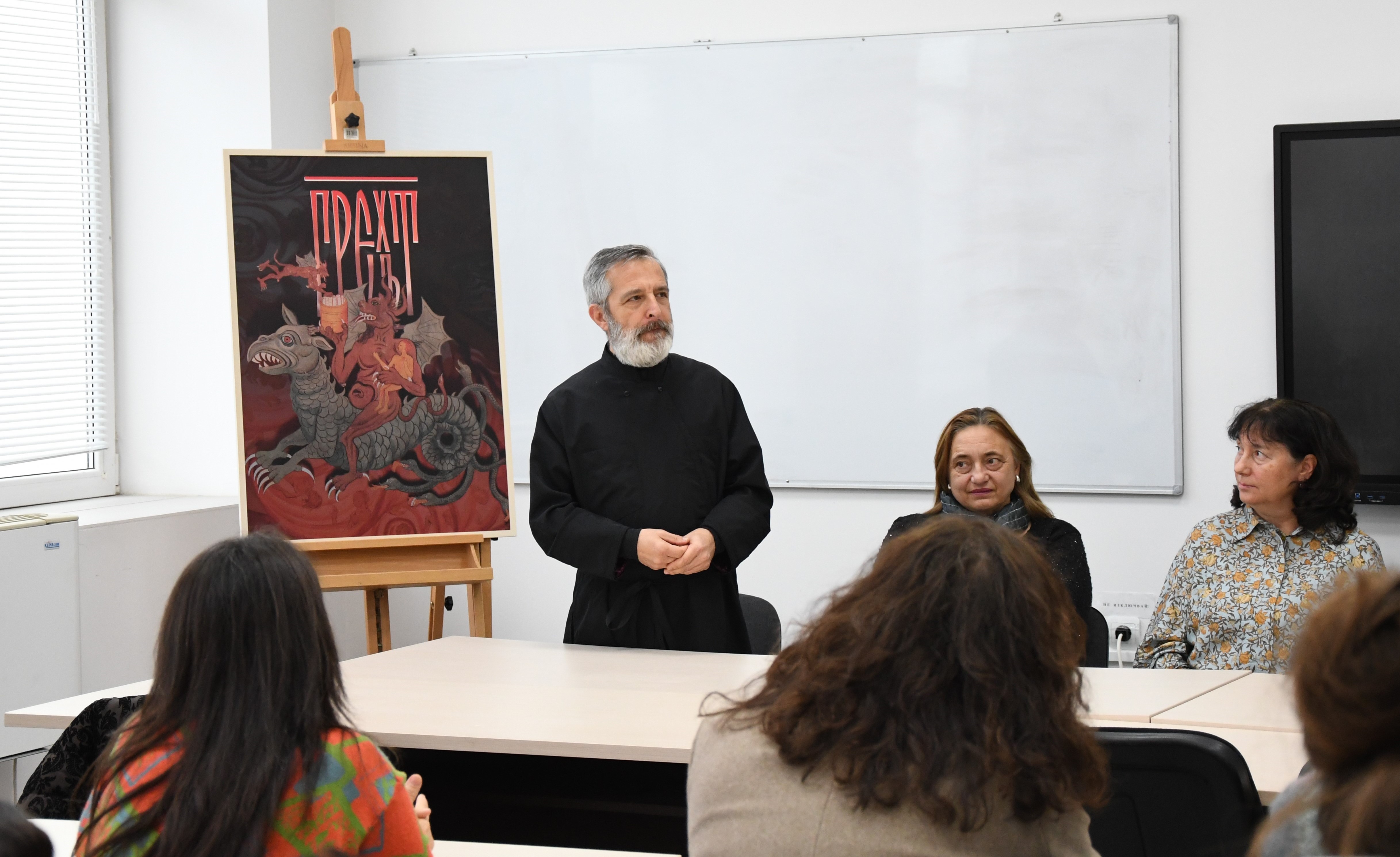
On December 4, in the hall “Prof. Dr. Lyuben Prashkov” of the Veliko Tarnovo University “St. St. Cyril and Methodius”, the mobile exhibition “Sin” of the Museum of Humor and Satire – Gabrovo was presented.
The event was held by invitation and in partnership with the Orthodox Theological Faculty, which hosts the exhibition.
The opening was attended by the Vice-Rector of the University, Prof. Dr. Vihren Buzov, the Dean of the Orthodox Theological Faculty, Prof. Dr. Magdalena Legkostup, deputy deans, lecturers, students, artists and iconographers – which placed the exhibition in a clearly academic and professionally contextualized framework.
The collection, presented under the title “Sin”, includes a total of 50 copies of frescoes and icons related to the theme of sin, made in the 1970s by a team led by art historian Asen Vasiliev. This team also included Professor Lyuben Prashkov – a fact that makes the exhibition of the collection in the hall bearing his name particularly significant.
In Veliko Tarnovo, 28 exhibition pieces presented information about the collection of copies, field studies to locate the originals and interpretations by experts on the subject. The selection makes it possible to trace different visual approaches to the motif of sin in Orthodox art – from stricter moral scenes to those in which elements of criticism, irony and a satirical attitude towards human weaknesses are clearly present. A particularly important context for this collection is the fact that a significant part of the originals from which the copies were made are today severely damaged, altered or inaccessible. Therefore, the copies acquire the value of a visual document and represent a key source for the study of specific mural cycles and iconographic solutions from the second half of the 20th century.
During the presentation, the deputy director of the Museum of Humor and Satire Nela Rachevits outlined the chronology of the creation of the collection and its study 50 years later. The beginning was set in the 1970s at the idea of the satirist and cartoonist Todor Tsonev, who drew attention to the satirical and comical in Bulgarian Renaissance art. On this basis, the museum team began to purposefully search for murals in various temples and monasteries in which reality – and in particular transgressions – are presented in a critical, sometimes grotesque manner.
In 2024, after a team from the Christo and Jeanne-Claude Center’s curatorial school began working on an exhibition related to the collection, the museum took the next step: it became clear that in addition to the collected copies, a contemporary narrative was also needed to connect them with today’s audience. Therefore, work on the collection resumed, now with a focus on additional documentation, analysis, and preparation of a future permanent exhibition.
The current stage of the project is being implemented with funding from the Ministry of Culture in 2024. The goal is to build a comprehensive package of materials – archival documents, photographs, expert texts, and field observations – that would serve as the basis for restructuring the presentation of the collection at the Museum of Humor and Satire. Rachevitz emphasized that plans were underway to renovate the museum building, rethink the tourist flow, and create a special space in which the Sin exhibition will be displayed in a permanent format.
The head of the field research for the project, curator Ilina Peneva, presented to the audience the specific steps in the team’s research work. Within the framework of the project, numerous temples and monasteries in the country were visited, where the condition of the original frescoes, changes in the interior of the temples and the reasons for the loss of certain images were monitored. Peneva emphasized that in a number of places the originals are missing entirely or are severely damaged, which makes the available copies not just “reproductions”, but a real basis for reconstructing the visual history of these frescoes. This material is also the basis for decisions on how to exhibit the panels – in a way that preserves the connection between the historical context, the research data and the perception of the modern audience.
The Dean of the Faculty of Orthodox Theology, Prof. Dr. Magdalena Legkostup, congratulated the museum team for the consistent work on the project and noted that the inclusion of a theologian in future stages would contribute to an even more complete analysis of the presented scenes and inscriptions. She also drew attention to the possibility of using the exhibition in the education of students of theology, Church history and Christian art. Father Dr. Teodor Enchev, who participated in the symposium (September 2025) related to the project, placed the collection in the context of the time in which it was created – the period of communism. He emphasized that some of the best specialists worked on the copies, and the dimensions and compositions follow the originals with high accuracy. According to him, these images clearly show both the condemnation and ridicule of sin –
humor and grotesque, which the artists of the Bulgarian National Revival used boldly and freely.
In the discussion after the presentation, the participants defined the project as an extremely valuable resource for specialists and for all those who work in the field of visual heritage, church history and cultural heritage. The exhibition “Sin” has already been shown in Dryanovo and is about to continue its journey to other cities and institutions. As part of the long-term work on the project, a bilingual monograph is planned to be published in early January, uniting the images and research texts of experts from various fields. By the end of the year, a specialized website is also expected to be launched, where a significant part of the collected materials will be available.
“Sin – a research and exhibition project” is realized with the financial support of the Ministry of Culture, in partnership with the VTU “St. Cyril and Methodius” and the Municipal History Museum in the town of Dryanovo, and the media support of the Bulgarian National Radio Program and BTA.
December 13, 2025, 10:00 AM The Library of the Museum of Humor and Satire Entrance: 5 BGN
We invite you to an extraordinary Christmas adventure! Children often imagine Christmas as a magical world, full of the aroma of cinnamon and bells. But behind this holiday lie stories, secrets and myths that have enriched the imagination of generations before us. And our studio “Stardust” is exactly the place where these stories come to life!
The studio combines storytelling of legends and myths, folklore elements and creative practice. It is built in such a way as to stimulate children’s curiosity about the traditions of Christmas, introducing them to various cultural images (saints, winter spirits, symbols of light) and directing them to create their own interpretation of the Christmas star. The main emphasis is on the connection between theory and creativity, between the acquired knowledge and the child’s personal expression. The workshop puts participants in the role of little researchers and creators who discover the meanings that have become part of the holiday culture.
What awaits you?
Mystical journeys through winter legends We will go back in time to when Saint Nicholas was not only the guardian of sailors, but also a symbol of generosity and kindness. We will see how from his figure the white-bearded old man we know today – Santa Claus, who travels the world with magic reindeer and a sack of gifts, gradually emerged. But… was he always accompanied only by good helpers? We will take a look at old European folklore and tell about the strange, sometimes frightening, but always interesting companions of Santa Claus. Some of them punish, while others scare.
Bulgarian Legends – Magic, Mystery and a Little Mischief What is the mysterious world of Bulgarian folk traditions and beliefs – where, according to legend, the karakondzhuli roam the earth on “dirty days”? A little mischievous, a little mysterious, they are part of folk legends about the dark world between Christmas and Jordan’s Day and the need for light and protection.
Suitable for children from 7 to 12 years old. Registration (places are limited!) A prior registration is required for participation: 0897 424 325 – Elena Milinova, events@humorhouse.bg
*Participation requires advance payment, which is made on site at the museum’s cash desk, 68 Bryanska Street, no later than December 10. The workshop will take place if no less than 5 participants are registered.
Prof. Dr. Lyuben Prashkov Hall (Hall 13), Building 11 of the University of Veliko Tarnovo.
The Orthodox Theological Faculty of the University of Veliko Tarnovo presents a visiting exhibition at the Museum “House of Humor and Satire” – Gabrovo on the topic “SIN” – a contemporary look at the unique museum collection of 50 panels, created in the 1970s, as copies of Renaissance frescoes.
The exhibition was first presented at the Municipal History Museum in Dryanovo, and on December 4 at 2:00 p.m. it will be opened in the “Prof. Dr. Lyuben Prashkov Hall” (Hall 13), Building 11 of the University of Veliko Tarnovo.
The Orthodox Theological Faculty maintains good partnership relations with the museum in Gabrovo, and plans are being made for joint projects in the future.
Half a century later, the museum team is conducting a large-scale study of all the temples from which the original frescoes originate.
Some of them are now severely damaged or lost, which turns the copies into a valuable historical document.
A monograph will be published as part of the project, which will present the entire process of research, analysis and interpretation of the collection as a basis for its future re-exhibition.
The exhibition includes:
– archival materials and reproductions from the collection;
– footage from field research;
– analytical texts by specialists in the fields of art, theology and psychology;
– contemporary interpretations of the place of the theme of sin in our cultural memory.
“Sin – a research and exhibition project” is realized with the financial support of the Ministry of Culture, in partnership with the University of Applied Sciences “St. Cyril and Methodius” and the Municipal History Museum in the town of Dryanovo, and the media support of the Bulgarian National Radio Program and BTA.
On November 26, the opening of the mobile exhibition “SIN” took place at the Ikonomov House at the Historical Museum – Dryanovo – a key stage in the new research and exhibition project of the Museum of Humor and Satire.
It presents a contemporary look at 50 fresco copies created in the 1970s, through which the theme of sin and its visual manifestations in the Bulgarian church tradition are explored.
The exhibition is organized into 28 panels, tracing the creation of the collection, the path of the images through time and their place in today’s visual imagination.
The Deputy Director of the Museum of Humor and Satire, Nela Ratchevitz, inaugurated the event and emphasized that the mobile exhibition is conceived as an interim “platform for reflection”, which makes visible the results of the ongoing research and prepares the basis for the renewal of the permanent exhibition “Sin”.
She emphasized the museum’s task of interpreting heritage not literally, but through contemporary cultural, social and psychological contexts.
Sava Hristov – manager of the Vidima Gallery and head of the Sin Research and Exhibition Project, highlighted the intensive and fruitful work on it, the significance of the prepared research and interpretive analyses and the added value of the professional contacts built during the implementation.
The official guest was the Deputy Mayor of the Municipality of Dryanovo Dilyana Dzhedzheva. The importance of the partnership between the institutions and the shared aspiration for a contemporary interpretation of cultural heritage was emphasized.
The Director of the Historical Museum – Dryanovo Ivan Hristov welcomed the guests and noted that it is an honor for the institution that the Dryanovo public is the first to see this working phase of the future exhibition transformation.
The project brings together experts from various fields: Prof. Raina Gavrilova (history of culture, Sofia University); Ch. Vladimir Dimitrov (History and Theory of Art, NBU); Dr. Slava Yanakieva (NBU); organizational psychologist Svetoslav Stoev; cartoonist Tchavdar Nikolov (“Pras Press”); Tatyana Tsankova – former director of the museum.
The field research, carried out by Ilina Peneva and Ivo Deliyski, covers churches and monasteries in Yablanitsa, Bachkovo, Churilovo, Kurilo, Lozno, Leshko, the Rila and Troyan monasteries, etc.
The collected documentation reveals a picture of preserved and lost frescoes – testimonies of tradition, memory and oblivion.
The central emphasis of the exhibition is the multi-layered reading of the images. “SIN” presents them not as edifying symbols, but as living cultural forms, whose meanings change over time.
Archival footage, field photographs, documents and expert analyses intertwine to show how sin is transferred from a moral category to a cultural issue – and how it can be presented in a museum environment today.
The materials and conclusions from the project will form the basis of the renewed permanent exhibition “Sin”, the development of which is pending.
In parallel, a website and a monograph are being prepared, which will unite the scientific and visual documentation.
The Sin Research and Exhibition Project s being implemented with the support of the Ministry of Culture, in partnership with the History Museum – Dryanovo and the Veliko Tarnovo University “St. Cyril and Methodius”.